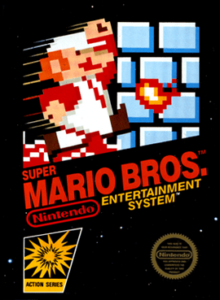
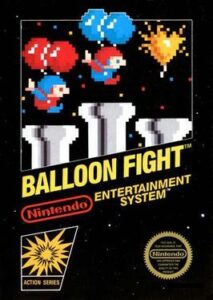
Nintendo Entertainment System - The Original 30 Games
The “Black Box Games”

It’s a long story, but the somewhat short version is that Atari nearly destroyed the in-home video game console market in the early 80s. In the mid-80s Nintendo, which was very popular in Japan, took a chance and wanted to introduce the Nintendo Entertainment System (NES) in the fall of 1985 in the United States. The problem was that retailers were not jumping at the new console. Eventually Nintendo offered to buy back any consoles and games that didn’t sell – making it zero risk for the few retailers that took the chance exclusively in New York City. At launch they released 17 games (chart at the bottom of this page) that all had similar cover art on a predominantly black box. It’s believed that a maximum of 10,000 of each of these games was originally produced – most of which were of course opened and played leaving few if any sealed copies. Flimsy boxes were often thrown away immediately, and those that weren’t suffered significant wear and tear over the years. The even more delicate manuals were extensively used (oftentimes as coasters) making mint copies very rare. And although cartridges were more sturdy and exist in huge numbers still today many have taken a beating through the years.
They didn’t fly off the shelves but it did well enough for Nintendo to follow up with a second market in Los Angeles in early 1986, eventually expanding even further before going nationwide in the fall of 1986. By now they had added 10 additional games including their “Arcade Series” with very well know, popular titles but they retained the well known black box design for all the games. In early 1987 the final 3 of what are known as the original 30 black box Nintendo Entertainment System games.

So what does this have to do with video game collecting and our special Black Box Insignia on our labels?

The easy obvious answer is that these games are essentially the rookie cards of the video game industry – the first games with a new system that launched the overwhelming success of Nintendo in the US for many years. But because these were early games that started in a small test market and Nintendo was growing quickly things were changing with each new production run of the games. And because of this we not only know these were original games, that nearly everyone who played the NES in the mid-80s played (because for a year they were the only games available) – making them a huge winner in the nostalgia factor of collecting, but we can also pinpoint which variation (or printing, or production) any given game box, cartridge and manual is through the years. Clear as mud. Probably the easiest way to illustrate it is in the chart below. If you still have a question, just ask.

We’ll examine this with the game box – it’s the easiest to spot and as complicated as it all can be, the box is the simplest thing to look at and help determine the variation. Just know that the manual and cartridge have a similar path that largely matches the progression of the boxes.

Variation (based on the original 17)

Key Elements of the Game Box

Additional Factors

A Picture Is Worth a 1000 Words

Variation (based on the original 17)

1st Variation (Oct 1985)

Key Elements of the Game Box

Matte Sticker – the first run of games exclusively in the test markets did not use shrink wrap; they had a sticker keeping the front flap closed.

Additional Factors

There was no ™ next to the words Entertainment System and there were no codes (more about that soon) on the back of the box. There was a punch tab perforated into the top of the back of the box.

Variation (based on the original 17)

2nd Variation (Early 1986)

Key Elements of the Game Box

Gloss Sticker – still no shrink wrap but now the sticker was glossy and left the words void on the box if peeled off carefully.

Additional Factors

No changes to the secondary factors – only difference between variation 1 and 2 is the sticker used to seal the game box.

Variation (based on the original 17)

3rd Variation (Summer 1986)

Key Elements of the Game Box

We have the first big change – getting bigger now Nintendo began using shrink wrap

Additional Factors

Again no changes to these factors – same box, just shrink wrapped not sticker sealed.

Variation (based on the original 17)

4th Variation (Fall 1986)

Key Elements of the Game Box

Nintendo adds a Game Pak (NES-GP) to the lower right corner of game boxes – right under the red Nintend logo.

Additional Factors

Still no changes here – but remember earlier we mentioned codes – this is what we meant. This is commonly referred to as a 1 code box.

Variation (based on the original 17)

5th Variation (Early 1987)

Key Elements of the Game Box

A second code is added to the back of game boxes. Now in the top left a game specific code was appearing. NES P XX where XX was specific to the game (i.e. NES P SM for Super Mario Bros.)

Additional Factors

With no other changes still this has given us a 2 code box, a slightly later production than the 1 code box.

Variation (based on the original 17)

6th Variation (Spring/Summer 1987)

Key Elements of the Game Box

We now see a ™ next to the word System on the front of the box.

Additional Factors

No other changes, this variation is sometimes referred to as a 3 code box, although the ™ isn’t the same kind of code we’ve referred to previously.

Variation (based on the original 17)

7th Variation (Q4 1987)

Key Elements of the Game Box

The die cut perforated hangtab on the back of the box is now gone.

Additional Factors

No other changes but this is considered a big milestone in the production stage of the black box games as production numbers of games is now getting very high so these are a bit more commonly available in the hobby.

Variation (based on the original 17)

8th Variation (1988 – Q1 1989)

Key Elements of the Game Box

Rev-A appears in the lower right corner of the front of the box.

Additional Factors

Rev-A marked the change in the cartridge from the 5 screw version to the 3 screw version that has “snaps” at the top of the cartridge. Another big milestone as production has seriously ramped up and costs are cut with this new cartridge version.

Variation (based on the original 17)

9th Variation (Mar 1989 – April 1990)

Key Elements of the Game Box

The previously seen circle seal of quality in the lower right corner of the front of all boxes to this point is now an oval seal of quality. Not to be confused with the matte and gloss sticker seals. Additionally, the color of these printed seals of quality is not indicative of anything – just the shape. Also note the oval seal has ™ underneath it.

Additional Factors

This printed seal of quality has also always been on the back of the box and it too is now oval. Additionally some other changes to the back of the box are in place but the lower right code is still there, only moved slightly. The introduction of the oval seal is the last major milestone for the black box games as we are now very late in production variations.

Variation (based on the original 17)

10th Variation (March 1990 – Dec 1994)

Key Elements of the Game Box

We just told you to note the ™ under the oval seal. It’s now a ® We must also note that somewhere around variation 9 and/or 10 the ™ next to SYSTEM changed to an ® but there is a bit of inconsistency and lack of clarity on exactly when this change occurred which is why it’s not specifically called out as a change – the change under the oval seal is much more noteworthy and reliable to signal a very late production variation.

Additional Factors

No other changes. Note – that not all games necessarily exist in this variation, it’s possible the previous variation was their last production run.

Variation (based on the original 17)

11th Variation (March 1990 – Dec 1994)

Key Elements of the Game Box

Some will argue that this should not be considered a variation at all or consider it included in the 10th variation but it is unique enough we put it in it’s own category. A star on the flap of the box. This was only on a few titles. It indicates a promotional copy of the game, not sold in stores. There isn’t too much known for certain about these but they are believed to be copies given away in contests, and possibly as samples.

Additional Factors

It’s important to note that many games may not exist with a star flap.

And just to keep us on our toes there are a few odd exceptions and an anomalies out there we know of…..

Volleyball has a version with no ™ next to the title of the game. All others in this original group have ™ next to the game title – including Volleyball, but Volleyball also has a box out there where this is missing.

Gumshoe and Balloon Fight for some reason seem to have a gloss sticker AND 1 code on the back available. Nobody seems to know why but it exists. There could certainly be other oddities like this but they are rare.

Double stickers are a thing – occasionally a game will have two matte or two gloss stickers on it. Even a gloss over a matte could exist. Again, nobody seems to know for certain why – common speculation is that if a game was returned the retailer would reseal it with a new sticker.

A VERY IMPORTANT THING TO KEEP IN MIND

Only the original 17 games (see chart below) can exist in all variations.

The second group of 10 start with the gloss sticker – so one of these 1987 released games a 1st variation is a gloss sticker not a matte sticker – which is why we note, “of 10” (not, “of 11”) on our black box insignia.

And the final 3 black box games from 1987 start with 2 code variations thus have only 7 possible variations but 1st variation, even though much later than the original 17, would be a 2 code, no ™, hangtab variation.

THE VIDEO GAME GRADERS BLACK BOX INSIGNIA

It’s this unique situation – with as many as 11 variations (or print runs, or production runs) of these highly collected and sought after titles that led us to create a special insignia (we have one for The Legend of Zelda too) to clearly identify which variation an NES black box game is in our cases since there is massive difference in overall production of the game in the 1st variation vs the 10th. We feel it’s very important to make this very clear – eliminating as much confusion as possible and bringing clarity at a glance to a very important factor about the game.

Learn more here, but this is a sample of what you’ll see on VGG labels for black box games:

The original 17, next 10 and final 3 aka The Original 30 NES Black Box games....

The Original 17 NES Black Box Games

Variations
1st – Matte Sticker / 2nd – Gloss Sticker / 3rd – No Code, No Sticker / 4th – 1 Code / 5th – 2 Code / 6th – 2 code + ™ / 7th – No Hangtab / 8th – Rev-A / 9th – Oval Seal ™ / 10th – Oval Seal ® / 11th – Star Code on Flap

The Next 10 NES Black Box Games

Variations
1st – Gloss Sticker / 2nd – No Code, No Sticker / 3rd – 1 Code / 4th – 2 Code / 5th – 2 code + ™ / 6th – No Hangtab / 7th – Rev-A / 8th – Oval Seal ™ / 9th – Oval Seal ® / 10th – Star Code on Flap*

The Final 3 NES Black Box Games

Variations
1st – 2 Code / 2nd – 2 code + ™ / 3rd – No Hangtab / 4th – Rev-A / 5th – Oval Seal ™ / 6th – Oval Seal ® / 7th – Star Code on Flap*
* Not all games are confirmed to have star flap variations but theoretically they could exist.

In accordance with our legal disclaimer all information contained on this page is deemed reliable but not guaranteed. These details regarding NES black box games are widely accepted and considered accurate within the hobby as of the publication date of this content, should significant changes to these facts become relevant Video Game Graders LLC will re-evaluate and as necessary update information on our website as well as on our products.

Last updated 5/2/2021

This website uses cookies to ensure you get the best experience while here.