

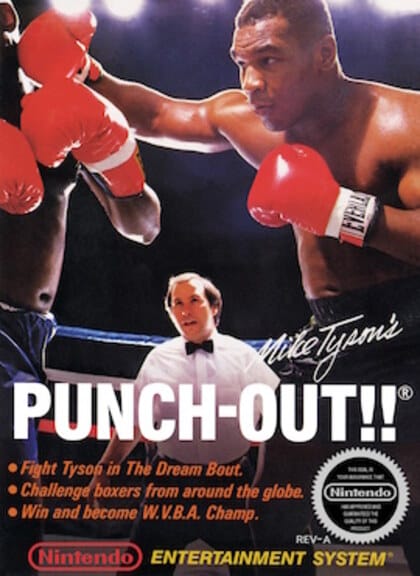
Little Mac was 107 pounds soaking wet, drawn about a third the size of every opponent he fought, and somehow that made the fights feel bigger. Mike Tyson’s Punch-Out!! hit North American shelves in October 1987, and for a lot of kids it was the first time a video game boss had a face they recognized from the actual news. That was the point. Nintendo of America president Minoru Arakawa watched Mike Tyson fight in person during the heavyweight unification series and left the arena convinced this guy needed to be in a game. Tyson wasn’t even champion yet. Nintendo licensed his name and likeness for a reported $50,000 over three years, a bet placed before he beat Trevor Berbick for the WBC title that November. It paid off enormously.
The game itself is a rework of Nintendo’s 1984 arcade original, retooled for the NES with Little Mac as a scrappy 17-year-old climbing through the World Video Boxing Association. You’ve got left and right jabs, body blows, and an uppercut that only unlocks once you’ve earned a star by reading and countering an opponent’s pattern. Fourteen opponents stand between Mac and the Dream Fight against Tyson himself, and Nintendo bent its own rules to make the boxing bout by bout memorable: Glass Joe fights to “La Marseillaise,” Piston Honda’s ring walk uses a Japanese folk song, and Mario himself shows up as the referee, apparently without anyone officially signing off on it first.
A hit that outsold almost everything
By 1988, Mike Tyson’s Punch-Out!! had sold more than two million copies in North America. Only one other NES game hit that number that year: The Legend of Zelda. Critics loved it just as much as buyers did. ACE magazine called it the second-best game on the NES in 1989, trailing only Super Mario Bros. Decades later, IGN ranked it 7th on its list of the best NES games ever made, and Nintendo Power put it 6th in a 2008 retrospective. That kind of staying power is rare for a licensed sports title. If you want the wider context on where this fits among NES essentials, our overview guide to vintage NES games is a good next stop.
Why Tyson disappeared from his own game
Here’s the part that trips people up. Tyson lost his titles to Buster Douglas by knockout on February 11, 1990. Nintendo’s three-year licensing deal expired around the same time, and the company chose not to renew it. So later that year, Nintendo quietly swapped Tyson out for a fictional palette-swapped boxer named Mr. Dream, stripped “Mike Tyson’s” from the title screen, and kept selling the cartridge as simply Punch-Out!! Every rerelease since, from the Virtual Console to the NES Classic Edition, uses the Mr. Dream version. Tyson has publicly grumbled that he didn’t even know his likeness had been pulled.
That contract quirk is exactly why this one matters for collectors. Two distinct North American cartridge versions exist for the same game, and only one carries Tyson’s name and face. The original 1987 Tyson cartridge has become the version serious collectors chase, and grading services see plenty of both floating around in wildly different condition. You can see examples of graded copies, Tyson version included, in our gallery of graded games.
Still in the cultural bloodstream
Jimmy Fallon had Tyson play the game live on The Tonight Show in 2014, and the virtual Tyson knocked out the real one in the first round. Family Guy has a whole joke about being stuck on Bald Bull. Nearly forty years later, people still remember exactly how to dodge Piston Honda’s counterpunch, which says something about how well this game was built in the first place. For the full history, Wikipedia’s entry on Punch-Out!! is worth a read.