

Two kids, one jeep each, one cramped TV screen between them. That’s Jackal on a weekend afternoon in 1988: grenades flying past the edge of the frame, a prisoner of war sprinting toward a chopper that hasn’t landed yet, and somebody’s older brother yelling about who stole the last continue. It’s the kind of shared-screen chaos the NES did better than almost anything else on the market, and Jackal is one of the better, stranger examples nobody brings up anymore.
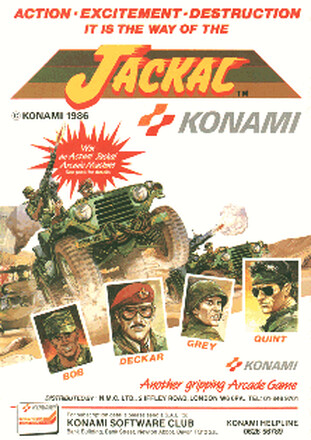
Konami built Jackal as an arcade cabinet first, releasing it in October 1986 in both Japan and North America. Here’s the part that trips people up: the North American arcade version wasn’t even called Jackal. Konami stuck the name Top Gunner on the US cabinet, kept the plain Jackal title for Europe, Oceania, and Asia, and ran the Japanese original under Tokushu Butai Jackkaru, “Special Forces Jackal.” Three regions, three different names on the same cabinet art.
Two years passed before the game reached a cartridge. When Konami finally brought it home to the NES in October 1988, the North American box said Jackal again, as though the Top Gunner machine at the arcade down the street had never existed. A Japanese Famicom Disk System release had already beaten it to shelves back in May of that year, retitled once more as Final Command: Akai Yōsai, “Red Fortress.” Nobody at Konami, it seems, could settle on what to call this thing.
The game itself is simple on paper. You drive an armed jeep across a war zone, shoot everything that moves, and free scattered prisoners of war so you can get them to a landing zone for airlift. A second player can drop in with their own jeep and work the battlefield at the same time, which is most of why anyone remembers it fondly. One button fires a grenade launcher that upgrades into a bazooka with enough pickups; the other fires a machine gun straight up the screen.
The NES version isn’t a straight port, either. Konami rebuilt it as something closer to a remake. The arcade ran vertically; the NES switched to a horizontal layout that gave the jeep more room to maneuver, and split the campaign into six lettered stages, Alpha through Zulu, each capped with a boss and a final fight against a flamethrower-equipped tank. Lose your jeep on NES and your weapon resets all the way back to the basic launcher, a harsher penalty than the arcade’s one-tier drop. On the plus side, the home version lets you haul as many POWs as a stage holds instead of capping out at the arcade’s eight, and it hides three power-up stars in the terrain that only appear if you shoot the right spot.
Nobody wrote the glowing magazine review that usually accompanies a game like this, or at least nothing from the period has survived to get quoted. The retrospective respect arrived later: IGN eventually slotted the NES version at 37th on its ranking of the best NES games of all time, solidly mid-pack company for a cartridge most collections skip over. The arcade cabinet, for what it’s worth, didn’t need anyone’s retrospective approval. Japan’s trade publication Game Machine listed it as the third-best-performing table arcade unit in the country for its November 15, 1986 issue, meaning it was pulling quarters before it ever got near a TV set.
Jackal isn’t a cartridge that commands attention in a grading gallery the way Contra or a Black Box title does, and that’s exactly why it’s worth a second look. Loose copies trade for around $11 today, nothing special. Add the original box and manual back and that number jumps to roughly $65, a reminder that packaging does most of the heavy lifting for value even on games nobody’s fighting over. If Konami’s other two-player wartime shooter is more your speed, we’ve already covered the game that made the Konami Code famous.