

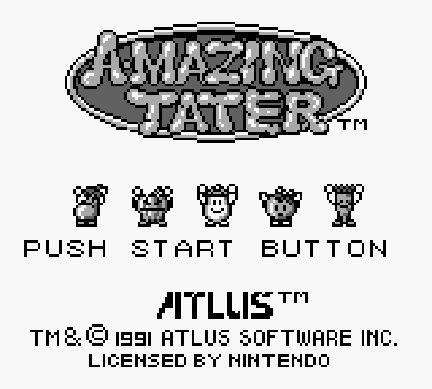
Somewhere in a box of forgotten Game Boy carts, there’s a decent chance one of them has a potato on the label, dodging a butcher knife, looking absolutely terrified. That’s Amazing Tater, and if you played it as a kid, you probably rented it once, finished it in an afternoon, and never thought about it again. Today a single loose copy is worth more than most people’s monthly car payment.
Atlus built Amazing Tater as a sequel to its 1989 puzzle game Kwirk, though you’d never guess it from the U.S. box — the connection only got played up in Japanese marketing. Japan got the game first, in August 1991, before it crossed over to American shelves in February 1992. The premise barely changed from its predecessor: you push a potato through a maze of crates, holes, and spinning rotator panels, trying to reach the exit before something in the kitchen turns it into dinner. There’s a practice mode, a standard puzzle mode, a beginner mode for anyone who wants the training wheels, and an “action” mode split into two mini-campaigns called Mega Picnic and Puzzle Forest.
Reviewers mostly liked it. Power Play gave it 82 percent and singled out the music, Play Time called it “a hot tip for fans of brain teasers,” and Germany’s Games-X handed it a solid 4 out of 5. Famitsu’s panel was cooler, splitting between 5s and 6s out of 10. Nobody was calling it the best puzzle game on the system. Nobody was panning it either. It was a quiet, competent little cart that did its job and got shelved.
Here’s where it gets interesting for anyone who collects instead of just plays. Amazing Tater earned a spot on our ranking of the 10 rarest Game Boy games, and the reasons are pretty ordinary: retail runs on puzzle titles like this one were small, nobody was clamoring for a reprint, and three decades of basement floods and yard-sale thinning did the rest. Current price guides put a loose cartridge at roughly $680. Find one complete in the box with the manual, and you’re looking at over $4,000 — numbers that put a game almost nobody remembers ahead of plenty of certified Game Boy classics.
That gap between “forgettable” and “four figures” is exactly why grading matters more on something like this than on a cartridge everybody already recognizes. A seller who doesn’t know what they’re holding will price it like common shelf filler. A buyer who does their homework can walk away with a genuine sleeper. If you’re chasing anything this obscure, it’s worth reading up on the quieter ways a Game Boy cartridge can lose value before it ever reaches a grader — our breakdown of dead batteries and dead saves covers blind spots that trip up even careful collectors.
Amazing Tater never asked to be famous. It was a mid-tier puzzle game sandwiched between bigger Game Boy releases in 1992, the kind of cart that got traded in at a video store and forgotten. Three decades later, scarcity did what quality reviews never could, and turned a game about a fleeing potato into one of the handheld’s quietest high-value holds. If you’ve got a copy sitting in a drawer somewhere, it might be worth checking its grade before you decide otherwise.