

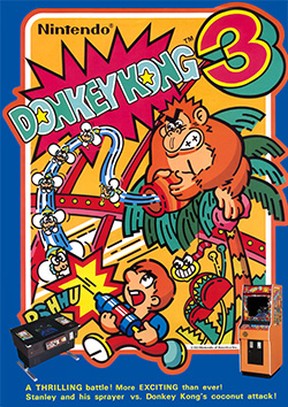
Somewhere between Donkey Kong and Donkey Kong Jr. in your mental timeline, there’s a third game that most collections quietly skip. Not because it’s rare. Not because it’s expensive. Because Nintendo handed the controller to a stranger named Stanley, took Mario off the box, and turned the whole thing into a bug extermination job.
Donkey Kong 3 started life in Japanese and North American arcades in October 1983, directed by Shigeru Miyamoto and produced by Gunpei Yokoi, with music from Hirokazu Tanaka. It didn’t reach NES cartridges until June 1986, well after the first two games had already defined what a “Donkey Kong game” was supposed to be. By then Nintendo had a problem on its hands: how do you make a third entry in a series that peaked on its first try, without just reskinning the same climb-and-jump structure a third time?
Their answer was to scrap the formula almost entirely. You don’t play Mario. You play Stanley the Bugman, defending his greenhouse from Donkey Kong, who dangles from vines at the top of the screen and keeps lowering himself toward Stanley’s flowers. Your job is to spray Donkey Kong with bug spray until he’s pushed back to the top, while also blasting the insects he’s dropping on you along the way. Beespies shatter into smaller, deadlier fragments when you hit them. A Super Sprayer occasionally appears on the vines, and grabbing it turns your pump into something closer to a flamethrower for a few precious seconds. It plays less like a platformer and more like a vertical shooter wearing a Donkey Kong costume, which is exactly what it is.
That’s a lot of change to ask longtime fans to swallow, and the reviews at the time were a genuine mixed bag. Play Meter gave the arcade original an 8 out of 10, and Computer and Video Games called it a “sure hit” with “fast action and superior sound effects.” Japanese arcades agreed, ranking it fourth among tabletop cabinets that November. North America was a different story. The game underperformed badly here, and retrospective writeups still point to Donkey Kong 3 as a big reason the series went quiet in the States until Donkey Kong Country showed up a decade later.
None of that stopped it from becoming a fixture of the NES’s earliest Black Box era, sitting on shelves alongside the other launch-window titles collectors still hunt for today. It’s also the odd cousin in a family that includes the original Donkey Kong NES port and the baffling Donkey Kong Jr. Math, which means an entire NES sub-series exists where the only consistent character across three cartridges is the ape, and he’s barely recognizable from one game to the next.
For collectors, that commercial stumble back in 1986 is part of why the cartridge isn’t exactly a budget pickup anymore. A loose copy runs somewhere in the $20s today, but complete-in-box copies climb well past $150, and sealed copies push into the high $200s, with graded examples bringing in a lot more from specialty sellers. It’s a reminder that a game nobody wanted in 1986 can still turn into a game everybody wants a clean copy of forty years later, which is more or less the entire logic behind grading in the first place. Check out our gallery of graded NES cartridges if you want to see what a well-preserved Black Box title actually looks like up close.
Stanley never got his own sequel on American shelves. Donkey Kong, as usual, landed on his feet and kept climbing.