

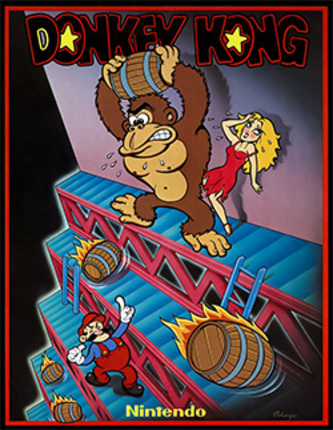
Everyone knows the scene even if they’ve never touched a controller: a giant ape hauls a woman up a tangle of girders while a mustached little guy in overalls climbs after them, dodging barrels. That image sold arcade cabinets by the tens of thousands in 1981. It didn’t actually make it to American living rooms in its complete form until June 1986, when Nintendo finally brought Donkey Kong home to the NES — and even then, the cartridge couldn’t hold the whole game.
Donkey Kong started as an arcade machine designed by Shigeru Miyamoto, with Nintendo R&D1 overseeing the project and Ikegami Tsushinki handling much of the actual coding. It was Nintendo’s first real hit outside Japan, and it introduced a character nobody names-checked for years: a plumber-shaped hero the instruction manual called “Jumpman,” because nobody at Nintendo of America had settled on Mario yet. President Minoru Arakawa pushed for the name change once the game started selling, and the rest is a seventy-billion-dollar franchise.
The woman in the pink dress has a name too. She was “Lady” in early documentation before someone borrowed the name of a Nintendo of America warehouse manager’s wife, Polly James, and turned it into Pauline. She wouldn’t get another starring role for decades, but she started it all right here.
Porting that arcade game to a cartridge wasn’t simple. Nintendo R&D2 handled the NES conversion, and early NES carts just didn’t have the memory for everything the arcade board could do. The 50-meter Cement Factory stage got cut entirely, along with most of the cutscenes between levels. What’s left is still a faithful, playable version of the original four-screen climb — just missing one rung of the ladder. Sharp-eyed players also noticed the hammer power-up paid out 500 points on NES instead of the arcade’s 300, a quirk precise enough that Game Genie hackers eventually coded a fix just to make the home version match the arcade exactly.
Donkey Kong launched as part of the NES Black Box series, the handful of titles Nintendo used to introduce the console to North America alongside Super Mario Bros. and Duck Hunt. That lineup is also the most fought-over shelf in the entire grading hobby, and this particular title proved it in dramatic fashion in 2025. A first-production, Gloss Sticker-sealed copy that had sat untouched for roughly forty years surfaced from a private trade, got authenticated after some understandable skepticism in a collector Discord, and went to auction. WATA graded it a 9.6 A++ — the only copy of that early print run the company has ever seen — and it sold for $370,880, the highest price paid for any video game that year.
It’s a reminder of how much a sealed box from 1986 can be worth once condition, print run, and grading line up, and it’s exactly the kind of history we track when we look at a cartridge that shows up at our gallery of graded games. Most copies of Donkey Kong floating around today are well-loved, label-worn survivors rather than factory-sealed unicorns, and that’s fine — this is a game that was built to get played, barrels and all.
Nintendo also had to defend the name in court. Universal City Studios sued over the King Kong connection, lost at the district level, lost the appeal in 1984, and then got hit with a $1.8 million judgment against it the following year for dragging Nintendo through the fight. It’s a strange footnote for a cartridge that, on the surface, is just a guy running up ladders.
If you want the fuller picture of where Donkey Kong sits among its Black Box launch siblings, we ranked the ten best NES Black Box games a while back. And the ape himself didn’t stay confined to the arcade original — he got a genuinely different sequel treatment eight years later on a much smaller screen, which we covered in our look at the Game Boy’s Donkey Kong remake.
The missing stage never really hurt the NES version’s reputation. It arrived five years after the arcade machine, memory limits and all, and still became the way most American kids actually met Mario, Donkey Kong, and Pauline for the first time.