

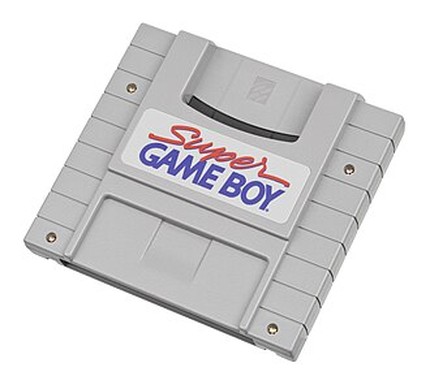
You plugged a Game Boy cartridge into a gray plastic shell shaped like a Super Nintendo cartridge, slid that into the SNES, and flipped the power switch. Four shades of green became an actual palette. A border popped up around the screen, filling the black bars your TV used to waste. For a kid who’d spent two years squinting at a handheld in a moving car, watching Mario show up in real color on the living room set felt like a magic trick nobody warned you about.
That trick had a name: the Super Game Boy. Nintendo released it in Japan on June 14, 1994, with North America following on July 22 at $59.99, and Europe picking it up that September. Hori built the hardware alongside Nintendo. In South Korea it sold under a different name entirely, the Super Mini Comboy, distributed through Hyundai Electronics, which says something about how far a little green cartridge traveled.
The clever part wasn’t the SNES doing the heavy lifting. It was the opposite. The adapter carried its own processor, running the real Game Boy software exactly as the handheld would, while the SNES just handled the video signal and painted on color. The system could show up to 12 colors on a moving screen (10 on a static one) and offered 64 possible border colors around the edges. Pop open the menu with L and R together and you got 32 preset palettes, nine stock borders, and a password system to restore any custom colors you’d dialed in yourself. There was even a “Graffiti” mode for hand-painting your own border with a Super NES Mouse, though Nintendo never let you save the thing. Turn off the console and your masterpiece was gone.
A handful of games used the hardware properly instead of treating it as an afterthought. Donkey Kong got a custom palette, a matching border, and an enhanced sound bite where Pauline actually yells for help. Dragon Warrior I & II swapped borders depending on where you stood on the map. Space Invaders hid an “Arcade” option that quietly booted the real SNES version instead of the Game Boy one. Multiplayer was the one real letdown — the original unit shipped with no link port at all, reportedly because Nintendo worried a cable would interfere with the TV’s RF signal — though a few fighting games allowed a second player with a spare SNES pad, and Wario Blast managed four-player chaos through the Super Multitap.
The Super Game Boy didn’t get to stick around. The Game Boy itself outlived everyone’s expectations, but Game Boy Color launched in 1998 without carrying the SGB’s color tricks forward — Pokémon Stadium’s Transfer Pak support was close to the only exception anyone got. Japan received a revised Super Game Boy 2 that same January, adding a proper link port and a handful of new default borders, before Nintendo quietly discontinued the whole line worldwide. Decades later, when Donkey Kong and Game & Watch Gallery showed up on the 3DS Virtual Console, both lost their Super Game Boy enhancements in the port. An entire generation of players never found out the color and sound upgrades had existed at all.
It’s a strange thing to grade or collect today, since it isn’t really a cartridge in the usual sense — it’s a cartridge-shaped computer with its own aging internals. A complete, working example matters more for the box, the manual, and a connector that hasn’t corroded than for anything you’d normally check on a Tetris cart. If you’re curious how that kind of condition assessment works on NES and Game Boy hardware generally, our gallery of graded games is worth a look. Most Super Game Boy units from 1994 still power on fine. The trick is finding one that still remembers how to paint in color.