

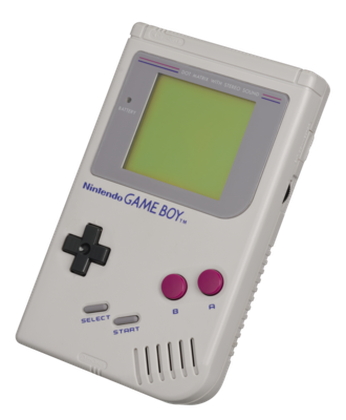
You remember the trip. Four batteries jammed into the back of a gray brick, a coiled headphone cord you never actually used, and somewhere around hour three the screen sliding into that faint yellowish tint that meant the batteries were finally giving out. Not dying. Fading. You had time to find an outlet, or a gas station, or just accept defeat and look out the window instead.
That slow fade was not an accident. It was the entire point.
The man behind it, Nintendo’s Gunpei Yokoi, had a phrase for his whole approach to hardware: “lateral thinking with withered technology.” Skip the cutting edge. Take parts that are old and cheap, technology everyone already understands, then find a clever new use for them. Yokoi had already proven the idea worked with Game & Watch back in 1980, built from the same unglamorous LCD chips found in pocket calculators. By 1989, he bet the same logic on something much bigger.
That bet was the Game Boy, launched in Japan on April 21, 1989, and in North America that July for $89.95. It shipped with a screen that could only manage four dull shades of green, and no backlight to see them by after dark. Its rivals looked embarrassing by comparison. Atari’s Lynx had a backlit color display and hardware sprite scaling years ahead of its time. Sega’s Game Gear ran color graphics close to a Master System’s, with a clip-on TV tuner if you wanted one. Sitting next to Nintendo’s gray slab, both looked like the future.
Both also drained six AA batteries in around four or five hours. The Game Boy ran up to 30 hours on four. On a road trip, in study hall, in the back seat on the way to grandma’s, that gap decided the whole war before it really started. Nobody wants the superior handheld that dies before lunch.
Price sealed it further. Nintendo undercut both competitors at launch, then paired the console with Tetris instead of a flashier pack-in game — a puzzle so simple it ran on almost nothing, matching the hardware’s own logic. By the time the Game Boy and Game Boy Color line was finally discontinued in 2003, combined sales sat close to 119 million units worldwide. The Lynx and Game Gear never came close. Sega’s machine finished a distant second. The Lynx barely finished at all.
That long production run, plus a shell built to survive actual childhoods, means a surprising number of Game Boy units and carts turn up in playable, even pristine, condition decades on. Sealed launch-era stock is a different story, though, and considerably scarcer than sealed NES product from the same years. Worth checking our best-selling Game Boy rankings if you’re curious which of those nearly 119 million units might be worth grading today, and our grading process if you’ve got a candidate sitting in a drawer somewhere.
Yokoi left Nintendo in 1996 and died the following year, but the lesson outlasted most of his competitors’ spec sheets. Building the smartest product on outdated parts, instead of the most impressive one on new parts, is how a gray plastic brick with a four-shade screen buried two consoles that looked far more like the future. Yokoi’s philosophy went on to shape nearly everything Nintendo made for the next decade, including a little device with two screens that also skipped its own graphics arms race.