

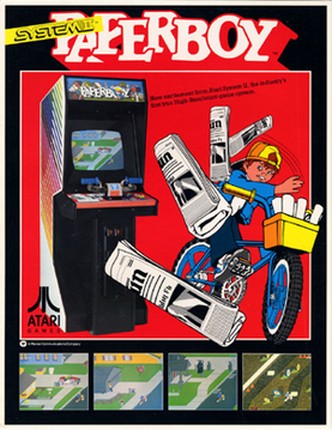
You remember the bike. The handlebars in the arcade cabinet actually turned. You leaned left, you leaned right, and somehow that made throwing a rolled-up newspaper at a mailbox feel like the most urgent job in America. Paperboy sold kids on the idea that delivering the news meant dodging runaway tires, angry dogs, and a guy on a skateboard who existed purely to ruin your week.
Atari Games built the original arcade version in 1985, reusing bike handlebar hardware the company had adapted from its Star Wars cockpit cabinet. It hit big fast, becoming the top-grossing arcade conversion kit in the U.S. that December. Nintendo owners had to wait three years for their turn. Eastridge Technology handled the NES port, and Mindscape published it in North America in December 1988, translating the arcade’s isometric street view onto a much smaller cartridge with a much smaller color palette.
The setup barely changed. You ride down “Elm Street” delivering The Daily Sun, tossing papers at subscriber homes while dodging cars, skateboarders, and a genuinely terrifying dog. Miss a subscriber and they cancel. Break a non-subscriber’s window instead, and you actually score points for it, which tells you everything about this game’s sense of ethics. Three difficulty settings double or triple your score, and the whole thing runs on a rotating three-day week that never lets up.
Reviewers didn’t agree on much. The arcade original got real praise for how well those handlebars translated chaos into control. The NES version got hammered. British magazine Mean Machines called it “a highly offensive product” and “a sadly derisive conversion,” which is a brutal thing to say about a game starring a kid on a bike. Other console ports fared differently — the Amiga version scored well, while the Game Boy Color release later got tagged as the worst of the bunch. Paperboy is a rare case where the exact same idea landed completely differently depending on which system you owned.
The trivia is where this one gets weird. Early design docs for the arcade game included enemies nobody asked for: giant snails, wandering ghosts, and a scientist who sat at a piano in the middle of the street. Focus testing killed nearly all of it, leaving only an old woman as the last survivor of that stranger draft. There was also supposed to be a playable papergirl alongside the paperboy. She got cut for a reason that sounds almost quaint now: not enough memory left on the cartridge to fit her in.
That kind of cartridge-space horse-trading is a good reminder of what these old carts actually had to squeeze into a few kilobytes of ROM, and why a clean, complete copy still matters to anyone tracking this era seriously. A boxed Paperboy cart with its bike-and-dog label still intact holds up better than most people expect for a game nobody thought would become collectible. If you’re curious what separates a beat-up loose cart from something worth grading, our gallery of graded video games is a good place to see the difference condition actually makes.
Paperboy never became a marquee NES title the way Mario or Zelda did, and it’s easy to miss it entirely if you’re only working through the console’s greatest hits. It’s still one of the stranger jobs Nintendo ever let you simulate, and one of the few games from 1988 where breaking the law was the whole point. For a wider sense of where a game like this fits into the console’s library, our overview of vintage NES games is worth a look too, and you can read more about the original arcade release on Wikipedia.