

Picture February 1989. The NES is already the hottest box under TVs across the country, but football games on it still look and play like checkers with shoulder pads — no real players, no real teams, nothing worth bragging about at school. Then Tecmo drops a cartridge that lets you snap the ball to Bo Jackson, hand off to Eric Dickerson, or throw deep toward Jerry Rice. Not “Running Back #23.” The actual guys.
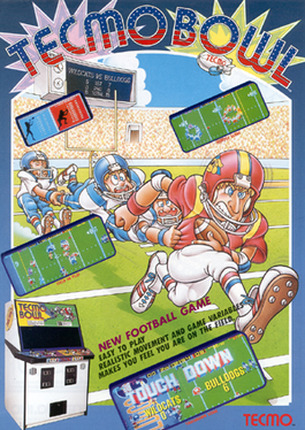
That cartridge was Tecmo Bowl, and it beat its own, far more famous sequel to the punch by two years. Tecmo Super Bowl gets talked about more today because of what Bo Jackson did in it, but Tecmo Bowl is the one that proved a home console could pull off real NFL talent in the first place. It started life as a 1987 arcade machine running on PlayChoice-10 hardware — the coin-op boards that let arcades rent out actual NES guts by the week, two giant screens and up to four players crowded around one cabinet.
Here’s the part that trips people up. The NFL never signed off on any of it. Tecmo only had a license from the NFL Players Association, which covers the athletes, not the league, the teams, or the logos. So the NES port hands you rosters pulled straight from the 1987 and 1988 seasons — real names, stats worth bragging about — stapled onto teams labeled by nothing but their city. Dallas, not the Cowboys. Chicago, not the Bears. No helmets, no shields, no official branding anywhere on the cartridge, and the league couldn’t do a thing about it.
Collectors chasing a complete, boxed copy today are really chasing a small miracle of licensing math: a product built entirely around a workaround that somehow still felt completely official. That gap between “technically unlicensed” and “the biggest sports game on the system” is exactly the kind of detail that makes an early sports cartridge worth a second look when you’re grading condition and trying to figure out what a sealed copy is actually worth versus a well-loved loose cart.
The gameplay earned the hype on its own. Twelve teams, four plays apiece, usually two runs and two passes, with San Francisco and Miami skewed toward throwing the ball. Defense worked by guessing — call the right play and you get a sack or an interception, call it wrong and you watch someone sprint untouched into the end zone. The NES version added one-player, two-player, and a coach mode that let you call plays instead of running every snap yourself, something the arcade original never offered. There was no save file. Win enough games and the cartridge handed you a password, usually scrawled on a notepad kept next to the console for safekeeping.
Reviewers noticed immediately. Computer Entertainer gave the NES port 7 out of 8 stars in 1989, and Nintendo Power later ranked it 30th on its list of the 100 best NES games ever made. Tecmo USA’s Dimitri Criona called it a “cultural phenomenon,” and for once that’s not marketing talk — this is the cartridge that convinced every football game afterward, all the way up through Madden, that real players were worth fighting a licensing battle to get.
Tecmo clearly took the lesson to heart. Two years later, it dropped the NFLPA workaround, locked down the real teams and the league’s blessing, and built Tecmo Super Bowl, the game most people actually remember playing. But that one doesn’t exist without this one. Tecmo Bowl is the rough draft that got good enough to make its own sequel necessary, and it’s still the better origin story. If you want to see where a complete, high-grade copy of an early sports cartridge like this one lands on the condition scale, the gallery of graded games is a good place to start looking.