

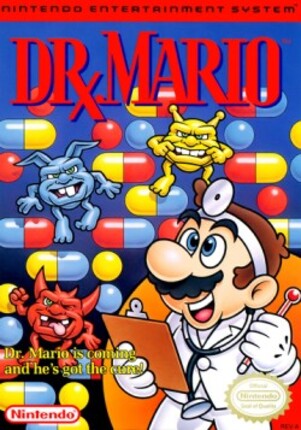
Two players, two screens, and a pile of capsules raining down between them — that was Dr. Mario’s basic pitch in the fall of 1990, and it turned a lot of otherwise polite living rooms into shouting matches. You’d line up a chain, clear six blocks in one drop, and watch a wall of garbage land on your opponent’s side a half-second later. Nobody warned you how personal a puzzle game could get.
Nintendo released Dr. Mario in North America in October 1990, following a Japanese debut on July 27 that same year — the NES and Game Boy versions launched side by side, not months apart like a lot of Nintendo’s cross-platform releases. Nintendo R&D1 built it, Gunpei Yokoi produced it, and Takahiro Harada programmed it. Yokoi is better known around here for the Game Boy and Metroid, not puzzle games, but Dr. Mario carries his fingerprints anyway: simple rules, a shallow learning curve, and mechanics built to work on hardware with almost nothing to spare.
The setup is straightforward. Capsules made of two colored halves fall into a bottle full of viruses, red Fever, blue Chill, yellow Weird, and lining up four matching colors, in a row or a column, wipes them out. Clear every virus on the screen and the level ends. There are twenty of them, and the game gets meaner as it goes, speeding up the drop rate until you’re making split-second calls instead of planned ones. The two-player mode is where it earns its reputation. Clear four or more blocks at once and the extra capsules dump straight into the other player’s bottle, which is the entire reason Dr. Mario still gets pulled out at parties decades later.
Composer Hirokazu Tanaka wrote the soundtrack, and “Fever,” the fast, looping theme that plays as the level speeds up, has outlived the cartridge itself. IGN later ranked it the seventh-best 8-bit game soundtrack ever written, and it’s been remixed by enough DJs that plenty of people know the melody without ever having touched a controller. The game did fine on its own merits too. IGN placed it 51st on its list of the best NES games, and it sold roughly 2.5 million copies in North America within six weeks of release. Worldwide, across every version Nintendo shipped it on, that number eventually passed 10 million.
None of that explains why Mario is a doctor, and Nintendo never really has either. The premise showed up fully formed, and nobody questioned the plumber’s new day job. That’s part of the charm. Dr. Mario doesn’t try to justify itself the way a lot of licensed puzzle games from the era did. It’s the same trick Nintendo used a year earlier with Tetris: strip a puzzle game down to something anyone can pick up in ten seconds, then let the difficulty curve do the rest of the work. The two games ended up sharing more than a release window. Nintendo eventually packaged them together on a single Super NES cartridge, and the pairing made enough sense that nobody blinked at it.
A loose Dr. Mario cartridge isn’t hard to find today. Nintendo sold millions of them, and the gray cart shows up in secondhand bins as often as any other NES game from 1990. What’s genuinely scarce is a complete-in-box copy with the manual intact and box art that hasn’t gone soft at the corners, the kind of condition that’s worth having checked before you decide what it’s actually worth. Our gallery of graded games is a decent place to see what separates a shelf survivor from something a collector will actually pay for. For more on the game itself, Wikipedia’s Dr. Mario entry has the fuller development history.