

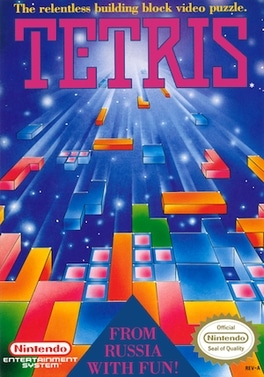
You rented Tetris the summer everyone rented Tetris. The video store’s copy was gone by Friday afternoon, so you drove to the mom-and-pop shop two towns over, the one with the wood-paneled walls and cartridges held shut with masking tape. Nobody standing at that counter in late 1989 realized they might be holding the wrong version. The one hardcore players still argue was better had already been pulled from shelves months earlier by a federal court order.
Nintendo’s Tetris for the NES hit stores in November 1989. Nintendo R&D1 built it from Alexey Pajitnov’s 1985 original, and Howard Phillips himself picked the color palettes. It sold fast: 1.5 million copies in six months, about $52 million in revenue, somewhere north of $135 million today. By 2004, worldwide NES sales had climbed past 8 million cartridges. Numbers like that made Tetris one of the best-selling games the console ever saw.
Here’s the part most casual players never learn. Atari Games’ console division, Tengen, had already released its own NES Tetris five months earlier, in May 1989. Legendary Atari programmer Ed Logg spent three years on it and packed in things Nintendo’s version lacked, including a genuine two-player competitive mode and a smoother difficulty curve. Tengen believed its distribution deal covered console rights. Nintendo disagreed, and had the paperwork to prove it: a March 1989 deal with Soviet licensing body ELORG worth five million dollars, granting exclusive home console rights.
A federal judge sided with Nintendo that June. The ruling ordered Tengen to pull its cartridges from every store in the country. Roughly 50,000 copies had already sold. Hundreds of thousands more came back off shelves, and Tengen’s Tetris more or less vanished from the market it had helped create.
Logg never got over it. “Heartbroken is a good summary,” he said years later. “It was so much better than the version Nintendo did.” Plenty of critics at the time agreed, praising the two-player mode and the sharper visual design. Nintendo’s version won anyway, because Nintendo’s version was the only one still legally on shelves.
That recall is exactly why this matters to collectors now. A game that got yanked from stores within weeks of launch doesn’t stick around in large numbers, and Tengen’s Tetris has become one of the more sought-after unlicensed NES releases as a result. Loose carts run over $100 today, complete-in-box copies clear $280, and a genuinely sealed copy can bring close to $700. Grading submissions for this cartridge are common, and buyers routinely overlook how much a matching box, manual, and factory seal change the number attached to a game with this kind of recall history. If you’re ever evaluating one, our gallery of graded games is a good place to see what separates a low grade from a high one on games with this kind of paper-thin production history.
Nintendo’s version, meanwhile, became the one an entire generation actually played, argued over, and eventually treated as unbeatable. It wasn’t, not quite. The game was built to end at level 29 by locking up, a kill screen nobody was supposed to reach through normal play. It took until December 2023 for a 13-year-old known online as Blue Scuti to actually crash the game into a true game over, using techniques like hypertapping that didn’t exist when the cartridge shipped. Thirty-four years is a long time for a puzzle game to keep a secret.
The Tengen version’s backstory connects to a fight that started even earlier, over on Nintendo’s other console. If you want the full story of how Tetris ended up defining Nintendo’s handheld launch before any of this NES drama played out, we covered how a missed fax in Moscow made Tetris the Game Boy’s launch game in an earlier post. Same rights, two different consoles, two very different outcomes.