

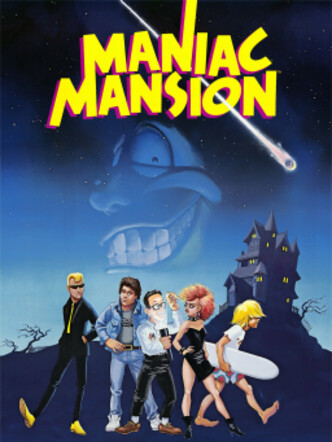
Dave Miller’s girlfriend Sandy just vanished into a crumbling mansion on the edge of town. The man holding her isn’t evil, exactly. Dr. Fred’s mind has been enslaved by a sentient meteor that crashed in his backyard twenty years earlier, and now he’s performing brain experiments in the basement because the meteor told him to. That’s the actual plot of Maniac Mansion, Lucasfilm Games’ 1987 point-and-click adventure, and by the time Jaleco ported it to the NES in September 1990, it had already built a cult following on home computers. Getting it onto a Nintendo cartridge meant getting it past Nintendo of America first.
The gameplay survived the trip mostly untouched. Dave brings two of his six friends into the mansion, each with a different skill. Razor and Syd both play instruments loud enough to pop a fuse box. Bernard fixes the microwave afterward. Which two characters you choose changes which doors open, which puzzles even have a solution, and which of the game’s five endings you reach. Characters can die along the way — this house is full of ways to go — and the survivors just keep moving. Only a total wipeout ends the game early.
The content around that gameplay got a much harder look. Nintendo’s standards left no room for nudity or profanity, so Realtime Associates project lead Douglas Crockford spent real time softening graffiti, trimming a line about brains, and removing a swimsuit calendar, a nude statue, and a mummy pinup, none of which affected a single puzzle. Even the “NES SCUMM System” engine credit got cut, the story goes, because Nintendo wasn’t fond of the acronym. It’s the same instinct that got Nintendo scrubbing blood out of Monster Party around the same era — a console aimed at kids, policed accordingly.
One joke got through anyway. Microwave Weird Ed’s pet hamster, and his sister’s dog eventually eats what’s left. Per Wikipedia’s account of the port’s development, that scene shipped in the first run of NES cartridges before Nintendo noticed, and Jaleco pulled it from every batch after that. Crockford later cited the hamster as proof the review process wasn’t exactly consistent. It’s also a small reminder for collectors that not every copy of a game is identical under the label — early production runs sometimes carry content, bugs, or printing quirks that later runs quietly correct, which is precisely the kind of detail that turns an ordinary graded cartridge into a genuine variant worth chasing.
None of the editing kept the game from landing. Entertainment Weekly ranked the NES version 20th among that season’s releases and praised the writing despite middling graphics. Nintendo Power later placed it 61st on its list of the greatest games ever made, and 16th among NES titles specifically. Jaleco manufactured roughly 250,000 cartridges, modest next to Super Mario Bros. but enough to make Maniac Mansion a real part of the NES library rather than a curiosity. The mansion’s layout was modeled on Lucasfilm’s own Skywalker Ranch, right down to a few rooms copied exactly, and a young tester on the port named Tim Schafer earned his first professional game credit here before co-creating Day of the Tentacle, the sequel that hid this entire original game inside itself as a playable easter egg.
Find a loose NES copy today and you’re holding a short, strange lesson in exactly how much a publisher could get past Nintendo’s gatekeepers in 1990 — and exactly how much slipped through by accident. Wikipedia’s write-up on the game’s development has the fuller story, hamster and all.