

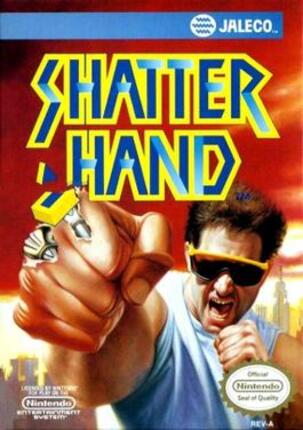
You rented it because the box art looked insane. A guy with chrome fists the size of cinder blocks, standing in front of an explosion, next to a word that sounded like a wrestling finisher. That was the entire pitch for Shatterhand at the video store in 1991, and somehow it worked. Nobody picking it off the shelf had any idea they were holding the American half of a Japanese superhero show.
Natsume built the game, Jaleco published it here in December 1991, and the original version had come out two months earlier in Japan as a tie-in called Tokkyu Shirei Solbrain, based on the real tokusatsu series Super Rescue Solbrain. Angel, a Bandai subsidiary, handled that release. For America, Jaleco stripped out the TV license entirely and rebuilt the story from scratch: Bronx cop Steve Hermann loses both arms fighting a cyborg army called Metal Command, gets rebuilt by a group called L.O.R.D., and comes back as Shatterhand. Same sprites, same stages, completely different man wearing the metal arms.
And the arms are the whole game. You punch everything. Bullets, robots, item crates, it doesn’t matter. A well-timed fist knocks projectiles out of the air instead of just dodging them, which turns every enemy volley into a math problem you can solve by hitting things. Coins drop out of destroyed crates and buy upgrades from vending platforms scattered through the seven stages: health, attack power, extra lives. Collect three matching robot parts and a satellite drone shows up to fight alongside you, one of eight possible helpers depending on what you’ve grabbed. It’s a side-scroller with the bones of a beat-’em-up, which is a weirder combination than it sounds.
Critics liked it fine without losing their minds over it. Electronic Gaming Monthly gave it a 32 out of 40, Nintendo Power landed around 3.75 out of 5. Solid, respectable, forgettable in the moment. Compare that to how differently America usually treated a stripped-out foreign license, like the glut of movie and TV tie-ins we ranked a few weeks back, and Shatterhand is almost the inverse case: a game that got de-licensed on its way into the country instead of slapped with a bigger one.
If the core hook sounds familiar, there’s a reason. NES developers loved building a whole game around one odd piece of body horror hardware, whether it’s a grapple arm that won’t let you jump or a pair of fists that double as a shield. Bionic Commando made its gimmick famous. Shatterhand’s version never got the same spotlight, which is most of why it’s still underpriced relative to how good it actually is.
That underpricing is part of what makes it worth watching if you collect. Jaleco cartridges from this era don’t carry the premium of a first-party Nintendo release, and Shatterhand never had the print run of something like Contra or Double Dragon. A clean, complete copy still trades for real but reasonable money, the kind of gap collectors look for before a game gets rediscovered and prices catch up.
They might be catching up already. City Connection re-released Shatterhand digitally on Switch this past September as part of its JALECOlle Famicom Ver. line, complete with rewind, quick save, screen filters, and a gallery of development art nobody outside Japan had ever seen. Thirty-five years after a Bronx cop with metal fists showed up on store shelves with zero explanation, somebody finally built him a proper museum exhibit. The original cartridge, box art explosion and all, is still the better way to meet him for the first time.