

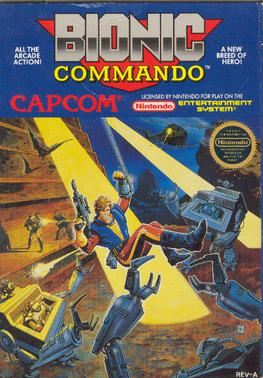
Every platformer on the NES in 1988 assumed you could jump. Mario jumped. Mega Man jumped. Even Blaster Master’s tank jumped. Then Capcom shipped a game where the soldier on the cover physically could not leave the ground on his own. If a gap opened up in front of him, jumping wasn’t an option. He fired a mechanical arm at whatever was overhead, latched on, and swung.
That soldier’s name is Ladd, and the game is Bionic Commando. It hit Japanese shelves on July 20, 1988, reached North America that December, and didn’t land in Europe until October 1990. Capcom built it loosely around its own 1987 arcade game of the same name, keeping the grappling-arm hero but reworking the whole structure into an open, map-based set of missions that plays closer to Metroid than to a straight side-scroller.
The missing jump button wasn’t a limitation the designers worked around. It was the entire point. Ladd’s bionic arm lets him swing across pits, climb sheer walls, and yank enemies clean off ledges — traversal built on momentum and timing instead of a simple hop. Level design leans into that constantly, asking players to think about swing arcs and grapple points in a way almost no other NES game bothered to.
The game’s original Japanese title was blunter than anything Nintendo of America would have allowed on a store shelf: Hitler’s Resurrection: Top Secret. The final boss really was a resurrected Hitler stand-in, and the enemy army wore swastikas. For the U.S. release, the swastika became a stylized eagle, “Hitler” was renamed Master-D, and the Nazi army turned into a generic faction called the Badds. Master-D’s face stayed exactly the same, so anyone paying attention noticed the resemblance survived the rename even after everything else got scrubbed.
Nintendo Power put Ladd on the cover of just its second issue ever and ran an eleven-page feature on him — serious real estate this early in the magazine’s run. The reputation held. Electronic Gaming Monthly slotted Bionic Commando into its top 32 console games of all time in 1997, GameSpot inducted it into its own greatest-games list in 2003, and GamesRadar later called it the fourth-best NES game ever made. Nintendo Power ranked it 17th on a 2008 all-time NES list, decades after that first cover story. None of that translated into a hit in Japan; Capcom’s own Ben Judd has said the game undersold there. The North American cult following never really faded, though, and it’s the reason Capcom keeps returning to the grappling-hook concept generations later.
For collectors chasing complete-in-box Capcom titles, Bionic Commando sits in an interesting spot. It’s recognizable and well-reviewed enough that demand stays steady, but it never had the scarcity of a low-print outlier like Blaster Master, another late-80s NES game that built its entire identity around one unconventional mechanic. Real desirability without extreme rarity is exactly the kind of cartridge worth having authenticated before anyone takes a “near mint” label at face value — box wear, manual condition, and cart-label fading all move the needle more than people expect.
Ladd never did learn to jump. He just made every other NES hero’s hop look a little unimaginative by comparison.