

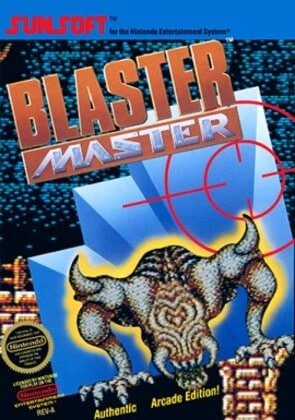
Somewhere in a Sunsoft office in 1988, a team of five people made a decision that would define an entire generation’s Saturday mornings: a boy chases his pet frog down a hole in the backyard, finds an armored tank, and spends the next eight levels blasting radioactive mutants to find him. That’s the plot. Nobody questioned it in 1988. Nobody questions it now.
Blaster Master hit Japanese Famicoms in June 1988 under the name Cho Wakusei Senki: Metafight, a much more self-serious sci-fi story about a soldier named Kane Gardner defending a planet called Sophia the 3rd from an invading army. It flopped. Sunsoft’s American division took one look at the anime-heavy plot, decided it wouldn’t land in the U.S. market, and asked the Japanese team to rewrite it. So the planet became a tank, the soldier became a kid named Jason, and the whole story got bolted onto a fish-bowl-jumping frog named Fred. By November 1988, Blaster Master was on American shelves, and it became the version most players actually remember.
What made it stick wasn’t the story. It was the structure. You spend most of the game piloting SOPHIA the 3rd, a tank that can climb walls, hover, and swim, blasting through side-scrolling caverns. Then you hit a doorway too small for the tank, hop out on foot, and the game switches to a top-down view straight out of the original Legend of Zelda. Two completely different game feels, stitched into one adventure, with a map that opens up Metroid-style as you find new abilities. Director Kenji Sada has said Metroid was a direct influence on the non-linear design, and it shows — you’re constantly backtracking to rooms you couldn’t reach before.
Critics loved the ambition. Electronic Gaming Monthly put it at number one in its very first “Top Ten Games” list, and Nintendo Power ranked it as high as number five in 1989, right behind Zelda II and the original Legend of Zelda. Decades later, both IGN and GamesRadar still list it among the best games the NES ever produced. But nobody who played it walked away calling it easy. There’s no password system and no save feature, so a loss late in the game meant starting over. Bosses regenerate if you leave and re-enter a screen. Players got so desperate that a glitch — pausing mid-explosion so a thrown grenade kept dealing damage while everything else on screen froze — became the accepted way to beat several bosses. It wasn’t a secret exploit. It was basically strategy.
The game’s afterlife is its own strange trivia stop. Scholastic published a novelization as part of its Worlds of Power series, and the author reportedly found Blaster Master the hardest of the bunch to write because the game barely had a middle to work with. Sunsoft liked the novel’s plot additions enough to use them as the basis for the 2000 sequel Blasting Again, making it the only Worlds of Power book that ever got canonized back into a game. A Game Boy spinoff, Blaster Master Boy, followed in 1991, and the series has been revived more than once since, most notably with 2010’s WiiWare reimagining Overdrive.
For collectors, original Blaster Master carts are common enough that they’re an accessible entry point rather than a grail, but condition still swings value hard — a beat-up label-worn loose cart and a crisp, complete-in-box copy aren’t playing in the same league. It’s the kind of cartridge worth a second look before you toss it in a box, and if you’re not sure what separates a mid-grade copy from a genuinely high one, our grading process breaks down exactly what graders are looking for.
It’s a game built on a plot nobody could defend with a straight face, made by a handful of people trying to prove something about what the NES could actually do. Judging by the “Top NES Games” lists it still shows up on almost 40 years later, they proved it.