

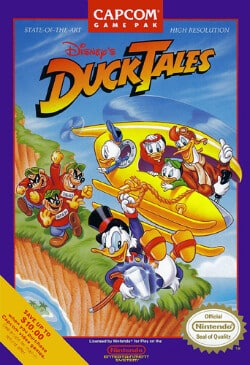
Every kid who grew up in front of a Nintendo in 1989 has the same story about licensed games: you begged your parents for whatever cartoon happened to be popular that year, and half the time you got a broken, rushed mess that barely resembled the show. DuckTales broke that pattern. Capcom didn’t hand this one off to a junior team. They gave it to the people who had just finished building Mega Man.
Disney’s DuckTales hit the NES in North America in October 1989, based on the syndicated cartoon that had turned Scrooge McDuck’s money bin into a household image. Capcom developed and published it in-house, notably the studio’s first fully self-developed licensed game, after farming out an earlier Disney project, Mickey Mousecapade, to Hudson Soft. The director was Keiji Inafune. The producer was Tokuro Fujiwara. Both had just come off Mega Man, and it shows in how tightly the game is built.
The whole design hinges on one idea: Scrooge’s cane. Tap it on the ground and it’s a melee weapon, cracking enemies and breaking open crates. Hold the jump button and bounce on it like a pogo stick, and suddenly you’re airborne, clearing spike pits and reaching ledges a normal jump could never touch. It’s a simple trick. It changes how every one of the game’s five stages plays, whether it’s the Amazon, Transylvania, the African mines, the Himalayas, or the Moon, tackled in whatever order the player wants.
That last stage is the one people remember. In 1989, sending a duck to the moon to hunt for alien treasure was a strange enough idea that it stuck. The Moon Theme that plays there became the single most recognizable piece of music the game produced, the kind of tune that gets stuck in your head decades later. It resurfaced in Capcom’s 2013 remaster with a fuller arrangement, and then, in a genuinely unexpected turn, it showed up again in the 2017 DuckTales cartoon reboot, rewritten as a lullaby Della Duck sings to her kids. A stage theme from an NES cartridge became emotional shorthand for a Disney show almost thirty years later.
DuckTales also did something most licensed platformers of its era didn’t bother with. It gave you a reason to replay it. How much treasure you’re carrying when you finish determines which of three endings you get. Rack up ten million dollars or more and you get the good ending. Finish with nothing and you get a considerably worse one, something only possible if you burn through all your cash on the life-restoring cheat and then limp to the finish line broke. It’s a small touch, but it rewarded the exact behavior the whole game is built around: greed.
Reviewers noticed the difference from typical tie-in fare. Electronic Gaming Monthly called it “a prime example of very good game design,” and it’s stayed in the conversation ever since. IGN later ranked it among the ten greatest games ever made for the system. Commercially, it became one of Capcom’s best-selling NES titles, with a Game Boy port following in 1990 that did nearly as well.
For collectors, an original 1989 cartridge is a genuinely fun hunt. Complete-in-box copies with the label art intact tend to hold their value well, partly because so many were played to death by kids who wore out the cardboard long before the cartridge inside quit working. If you’ve got one sitting in a drawer, checking how the box, manual, and cart have held up is worth doing before you assume it’s just a nostalgia piece.
The team that built Mega Man could have phoned in a cartoon tie-in and nobody would have blinked. Instead they built one of the tightest platformers on the NES, and thirty-some years later, kids who’ve never seen the original cartoon still hum that Moon Theme without knowing where it came from.