

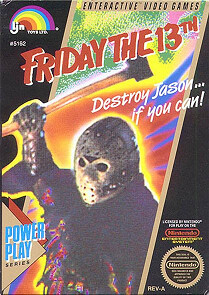
You rented it expecting a slasher movie you could control. Blockbuster had the box right there at eye level, Jason’s hockey mask staring out at you, and for a kid in 1989 that was enough. Then you popped in the cartridge, picked a counselor, and spent the next twenty minutes walking in circles around Camp Crystal Lake trying to figure out which cabin had the ax in it. Nobody told you the lake connected to itself in ways that made no sense. Nobody told you a kid could die off-screen while you were still three screens away. Welcome to one of the strangest licensed games the NES ever produced.
Friday the 13th came from Atlus, developed in Japan and published in North America by LJN in February 1989. LJN had already built a reputation for turning movie licenses into NES games of wildly uneven quality, and this one split the difference between ambitious and baffling. The pitch was simple: pick one of six counselors, each with different speed and throwing strength, and keep the kids at camp alive across three in-game days while hunting down Jason three separate times. The execution was anything but simple. A junior Atlus staffer named Ryutaro Ito, who later worked on the Shin Megami Tensei series, play-tested the game and found it brutally hard. He later said American publishers specifically pushed Japanese developers to crank up the difficulty on their NES titles, and the internal team reportedly nicknamed the project “13 Kin.”
What actually makes Friday the 13th interesting almost forty years later isn’t how it plays. It’s what it was trying to do. The game runs on a day-and-night survival loop: explore the woods, the lake, and the cabins, manage which campers are still breathing, and race timers before Jason reaches a cabin full of kids. That’s a resource-management structure the NES rarely attempted in 1989, years before “survival horror” was a label anyone used. The cabin confrontations even borrow their rhythm from Punch-Out!!, trading blows with Jason until he retreats. None of that stopped critics at the time from hating it. GamePro dinged its “repetitive music score and amazingly frustrating gameplay,” and by 1997 both Electronic Gaming Monthly and Nintendo Power had it ranked among the worst console games ever made.
The game earns a spot alongside the other licensed horror attempts of the era, a group we covered when ranking the creepiest games on the NES. Most of those licenses failed outright. Friday the 13th at least tried something structurally different, even if the execution buried the idea under a maze of identical-looking screens and a flashlight mechanic the manual explained incorrectly.
Collectors have caught up to the game’s cult status. A complete-in-box LJN cartridge from this era isn’t rare, but condition separates a common $15 loose copy from a sealed or high-grade example that pulls serious money at auction, partly because LJN boxes used thin cardboard that dings and crushes easily compared to Nintendo’s own packaging. If you’re sitting on a copy and wondering what it’s actually worth, that’s exactly the kind of grading question we deal with daily — browse the gallery of graded video games to see how condition translates into real value.
Is Friday the 13th a good game? No. Ask anyone who’s tried to find the last camper hiding in a cabin loop. But it’s a weird, ambitious swing from a studio under pressure, and that’s a more interesting story than another forgettable movie tie-in. Decades of “worst games ever” lists gave it a reputation. The actual game is stranger than its reputation, which is usually the better story anyway.