

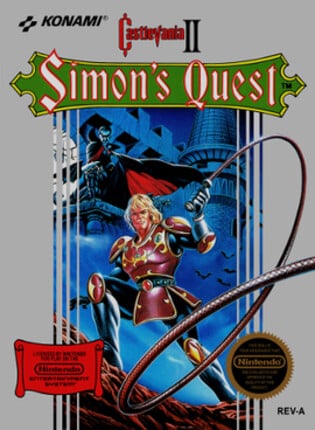
Somewhere in a graveyard, an old man tells you to hit a cliff with your head. You do it, because what else are you going to do, and nothing happens. That line, garbled by a rushed translation, became one of the most quoted moments in NES history. It also happens to sum up the entire experience of playing Castlevania II: Simon’s Quest in 1988: everyone in this game is lying to you, and you have no way of knowing it until you’ve wasted an afternoon.
Konami built the original Castlevania as a tight, linear whip-and-jump gauntlet. For the sequel, they threw that formula out. Simon’s Quest released in Japan on the Famicom Disk System on August 28, 1987, then crossed over to American NES cartridges on November 24, 1988. It swapped the original’s stage-by-stage structure for an open, connected map, added a day-night cycle that made nighttime enemies hit harder and hunt in packs, and let Simon Belmont buy new gear from villagers using hearts as currency instead of sub-weapon ammunition. For a series that had just proven itself as a horror-platformer, this was a real gamble.
It paid off commercially. The game moved more than a million copies, and Famitsu readers gave it a respectable 28 out of 40 at launch. But the goodwill only went so far. Western reviewers, then and later, zeroed in on the same problem: the clues meant to guide players through the map were either useless or actively false. Talk to the wrong villager and you’d get sent digging at a random cliff face for no reason at all.
Decades later, series producer Koji Igarashi confirmed there was a reason for the confusion, and it wasn’t just sloppy localization. In the original Japanese script, some of those NPCs were written to lie on purpose, part of a puzzle design that expected players to cross-reference hints and figure out who was trustworthy. The English translation dropped that context, so “Deborah Cliff” just reads as nonsense rather than a riddle with a rigged answer. What was meant as clever misdirection became, for a generation of American kids with a Nintendo Power subscription and no internet, a genuine wall.
Time has been kinder to the game than 1988 was. Modern retrospectives tend to credit Simon’s Quest for pushing an action series toward exploration and light RPG mechanics years before that combination had a name. The nonlinear castle-hopping, the gear you had to earn and buy, the sense that the map hid more than it showed — all of it points fairly directly at the design language Konami would return to a decade later with Symphony of the Night, the game that eventually gave the “Metroidvania” genre its name.
For collectors, Simon’s Quest sits in an interesting spot. It sold well enough that loose cartridges are easy to find, but a genuinely clean complete-in-box copy, label crisp and manual intact, is a different story after nearly four decades of rental-shop handling and basement storage. If you’re checking authenticity on an older cartridge before you decide what it’s worth, our grading process walks through exactly what we look for.
The lesson of Castlevania II is a little bit timeless: don’t trust anyone in a graveyard, in 1988 or now.