

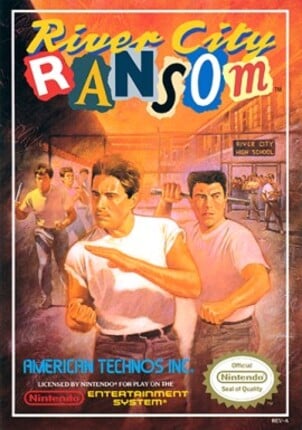
Picture it: you’re two gang fights into the afternoon, your knuckles are sore, and instead of grabbing a power-up you walk into a burger stand and buy a hamburger. That’s a normal Tuesday in River City Ransom, and it’s still one of the strangest, funniest ideas the NES ever committed to a cartridge.
Technōs Japan released the game at home first, as Downtown Nekketsu Monogatari in 1989. It was the third Kunio-kun title to reach the NES, following Renegade and Super Dodge Ball, but the first one actually built for the console instead of adapted onto it. American Technōs brought it to North America in January 1990 as River City Ransom, and the setup reads like a straight arcade brawler: you and your friend Ryan fight through nine color-coded gangs across town to rescue Ryan’s girlfriend Cyndi from an extortionist who is, with admirable lack of subtlety, named Slick.
The similarity to a standard beat ’em up stops almost immediately. There’s no scrolling corridor here — River City is one open, non-linear map, and every dollar you punch loose from an enemy’s pocket can be spent at the shops scattered around it. Burger joints and bookstores sell items that permanently raise your stats. Eat enough food and your strength climbs for good. Buy the right book and you learn a whole new move. It’s a role-playing game wearing a street brawler’s jacket, years before anyone had a tidy genre label for that combination. The connection to Double Dragon isn’t just a family resemblance, either — Technōs made both games, which makes River City Ransom feel less like a knockoff and more like the same studio asking what its own formula would look like with an inventory screen bolted on.
None of the shopping is what people actually remember, though. Knock out an enemy and they let out a single strangled shout: “BARF!” In the Japanese original it was a generic gagging sound effect, nothing anyone there particularly noticed. The English translators needed something that read as a distressed retch, landed on BARF, and accidentally created the game’s whole personality. It stuck so hard that later River City games kept using the line specifically because English-speaking fans wouldn’t let it go — a throwaway localization choice that ended up outliving the sound effect it was translating.
None of this saved the game commercially in 1990. Reviews were mixed at launch, and a brawler that kept sending you into a bookstore was a tough sell next to Double Dragon and its imitators. The reappraisal took years, built almost entirely on people who’d rented it once and never forgot it. IGN eventually scored it a 9 out of 10, and GamesRadar has slotted it into its top ten NES games list more than once. That’s the arc a lot of genuine hidden gems follow: ignored on the shelf, championed everywhere once nostalgia and hindsight catch up to it.
That same commercial softness matters on the grading side today. A game that never moved units like a pack-in title doesn’t generate the volume of surviving copies that flood the market for something like Super Mario Bros., so clean complete-in-box examples turn up less often than the game’s current reputation might suggest. Box wear, manual condition, and how well that Technōs cover art has held its color all factor into what a copy actually grades. If you’ve got one sitting in a closet, it’s worth having someone who knows what to look for take a real look at it.