

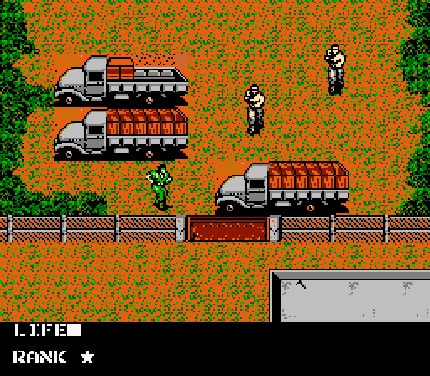
Every NES kid in 1988 knew a code for something. Konami’s own up-up-down-down trick worked in Contra. Somebody’s older brother swore he knew one for a game he probably didn’t own. But if you had Metal Gear, you knew a different kind of code: a string of profanity typed into the password screen that dropped you straight into the final boss fight with an empty inventory. It worked. Nobody at Nintendo of America ever explained why.
That code says almost everything about the game around it. Metal Gear on the NES was rushed, reshuffled, and barely related to the game its own creator built. It still sold a million copies in the United States and kept a franchise alive that nearly ended after a single release.
Hideo Kojima made the original Metal Gear for the MSX2 home computer, released in Japan in July 1987. It was his first game as director, built around an idea almost nobody in action games was selling yet: avoid the fight instead of winning it. Sneak past the guards. Hide in a box. Run when you’re spotted instead of shooting your way out. The MSX2 never reached North America in any real way, so when Konami wanted an American release, the job went to Ultra Games, the in-house label the company used to get around Nintendo’s strict limit on how many titles one publisher could release each year.
A separate Konami team built the NES version on a three-month deadline, and by most accounts, Kojima had no say in it. Staff were reportedly told to make it as different from the MSX2 original as the schedule would allow. The underwater opening became a jungle parachute drop. The showdown with the towering Metal Gear machine became a fight against a supercomputer guarded by soldiers. Three infiltration zones turned into five buildings, and the helicopter boss battle disappeared entirely, swapped for stationary gunners. Kojima later called the port out by name and made it clear he wanted nothing to do with it.
The Ultra Games branding on that box matters for another reason. It’s not Nintendo’s own black-box seal, and small packaging details like that are exactly the sort of thing that separates one graded copy from another. If you’ve never seen how graders actually work through a cartridge and box like this one, how it works walks through the process.
None of that behind-the-scenes mess stopped the game from landing. American reviewers had rarely seen an action title ask players to run from a fight instead of winning one, and the strategy-over-firepower pitch stuck. Metal Gear climbed to number two on U.S. sales charts in October 1988, behind only Super Mario Bros. 2, and held a top-ten spot into early 1989. A million U.S. copies moved for a cartridge whose own director wanted it erased.
The passcode trick got enough attention that Konami’s European release changed its entire password system to strip out vowels, just so players couldn’t spell anything crude enough to trigger a skip. A password made entirely of consonants sounds like a minor fix. It’s also a strange kind of tribute: proof that a cheat code embarrassed a multinational company enough to rebuild a whole system around it.
Kojima’s frustration didn’t end with the NES port. Konami’s U.S. division followed it with Snake’s Revenge, a sequel built without him, which pushed him to make his own true follow-up, Metal Gear 2: Solid Snake, for the MSX2 in 1990. That game, not the American one, is the one that actually sets up Metal Gear Solid. The NES version most Americans grew up with is, by its own creator’s account, a footnote he didn’t write.
For collectors, that history barely dents the demand. A million-seller means loose carts are everywhere and cheap, but complete copies with an intact Ultra Games box are a tougher find in real condition. Thin cardboard and flimsy manuals didn’t survive many childhoods. Curious what a graded example next to a common black-box Nintendo title actually looks like side by side? The gallery of graded NES games is worth a look.
Metal Gear on the NES isn’t the game Kojima made. It’s the game an entire generation played anyway, passcode-skipping and all. Somehow, it’s still the version most people picture first when they hear the name.