

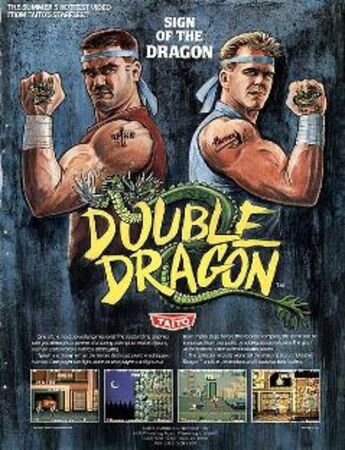
You and your best friend used to split into Billy and Jimmy Lee at the arcade, working through the Black Warriors together, taking turns getting knocked into a pit by a pink-mohawked strongman named Abobo. Then Double Dragon showed up on NES in June 1988. You fed in the cartridge expecting the same deal. Something had changed. There was no second controller option. Worse, your buddy’s character wasn’t waiting to team up anymore. He was waiting at the end of the game, revealed as the real leader of the gang you’d been fighting the whole time.
That twist wasn’t a creative flourish. It was damage control. Technōs Japan built the arcade original in 1987 and got the NES port as only its second-ever game on the console. The programmers were still learning Nintendo’s hardware, and simultaneous two-player action turned out to be more than the system could reliably handle. So they cut it, rewrote Billy and Jimmy’s relationship from brothers-in-arms into hero and traitor, and shipped what they had. The new plot papered over a technical limitation so well that plenty of kids assumed it had been the story all along.
The compromises didn’t stop anyone from buying it. Double Dragon reportedly sold out at Toys “R” Us within its first two weeks on shelves, moved 100,000 copies in its first month in the US, and became the country’s best-selling game by July 1988, with demand climbing toward a million cartridges by that Christmas. For a beat ’em up missing its headline feature, that’s a remarkable run. The fighting, a new leveling system, and a bonus Mode B versus fight carried it even with just one player at a time.
Under the hood, the NES version earned its rough-around-the-edges reputation in more ways than the missing co-op. The system could only display two identical enemies on screen at once. Weapons vanished the moment you cleared a wave of thugs. And the whole cartridge shipped with a stack of bugs that players noticed almost immediately, a side effect of that same hardware learning curve. Technōs also built in things the arcade never had: a leveling system that let Billy grow stronger through seven ranks, a brand-new cavern section in the third mission, and a boss, Chin Taimei, invented just for this version. Less a straight port than a rewrite wearing the same box art.
None of that stopped it from becoming a formative NES memory for a generation of collectors, which is exactly why condition matters so much on this one now. A million-plus cartridges out in the wild means loose copies are everywhere and cheap. What’s genuinely scarce is a complete-in-box copy that survived a childhood of being rented, argued over, and stuffed in a bag next to the console, box corners still square and the label never scuffed against the cartridge slot. That’s the gap between a common find and something worth real money. Not the game itself. What’s left of the packaging around it.
Double Dragon shares a lot of DNA with Contra, another 1988-era rental-store staple that got harder on NES than anyone expected and turned that difficulty into a badge of honor for the kids who beat it. If you’re curious what actually separates a well-preserved copy from a beat-up one, our grading breakdown walks through what graders look for before a cartridge ever gets a number.