

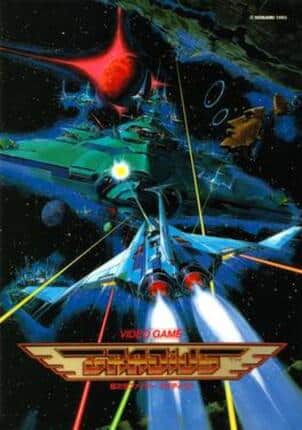
Everybody who owned this game in 1987 eventually heard the code from someone at school, whispered like a secret handshake. Up, up, down, down, left, right, left, right, B, A. Type it on the title screen and your ship showed up armed to the teeth before the first Moai head even fired a shot. Most kids never knew they were about to become part of gaming trivia forever. They just wanted to survive stage one.
Gradius started life in Japanese arcades in May 1985, built by a Konami team led by Hiroyasu Machiguchi as a loose spiritual successor to the studio’s 1981 shooter Scramble. You flew the Vic Viper, a sleek starfighter up against the Bacterian Empire, blasting through space caverns and alien fortresses in a side-scrolling shooter that looked simple and played anything but. The arcade cabinet was a hit fast, finishing as Japan’s fifth highest-grossing table arcade game of 1986 and topping the charts in London the same year.
The reason it stuck was the power meter running along the bottom of the screen. Instead of grabbing a power-up and instantly gaining a new weapon, you collected capsules that advanced a menu of upgrades: Speed Up, Missile, Double, Laser, Option, Shield. You picked the moment to cash in, which meant every capsule was a small gamble. Grab one more for a better weapon, or lock in the upgrade you already earned before a stray bullet sends you back to square one. The Options were the real signature move: small satellite drones that trailed the Vic Viper and mimicked its movement a beat behind, multiplying your firepower without ever feeling automatic. The arcade version allowed up to four of them. Konami’s design team reportedly tested more than twenty different movement patterns before landing on the one that shipped.
The Famicom version arrived in Japan on April 25, 1986, and the NES cartridge followed in North America that December, one of the earlier third-party releases in the console’s American library. Hardware limitations cut the Option count down to two, a real loss for anyone who’d played the arcade original, but the core game translated cleanly. It also kept the name Gradius everywhere, even though Konami had rebranded the arcade export version Nemesis for markets outside Japan.
That famous code has a more practical origin story than most gaming legends. Konami programmer Kazuhisa Hashimoto built it into the Famicom port as a debug shortcut, a way to skip the grind of playtesting a brutally difficult shooter over and over. It slipped into the shipped game and reappeared in Contra, Life Force, and a long list of other Konami titles, eventually earning its own name: the Konami Code. Four decades later it still shows up as an Easter egg on websites that have nothing to do with video games, which is a strange kind of immortality for something meant to save one exhausted tester some time.
The Famicom release sold more than a million copies in Japan in 1986 alone and picked up Famitsu’s award for Best Shooting Game, along with a second-place finish for Game of the Year. It arrived on the NES in roughly the same launch-window stretch as Konami’s other early hits, the same era we covered in our look at Castlevania, when a Konami logo on the box already meant something to renters browsing the shelf.
Complete copies turn up fairly often since the cartridge sold well and wasn’t especially fragile, but box condition varies more than you’d expect for something this common. Corner wear and sun-faded artwork are the usual culprits that separate a nice shelf copy from one that grades well. If you’ve got a copy tucked away and you’re curious where it actually lands, our grading process walks through exactly what we check.