
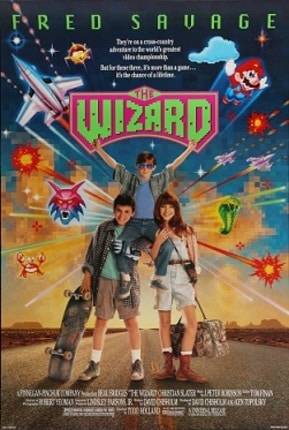
Somewhere out there is a kid who saw The Wizard in a theater in December 1989 and remembers exactly one thing about it: a glowing screen showing a game nobody had played yet. Not the plot. Not Fred Savage. Just Super Mario Bros. 3, running on a console at a fake video game tournament, two months before you could actually buy the cartridge.
That’s the whole trick of the movie. The Wizard follows Corey Woods (Savage) driving his emotionally withdrawn little brother Jimmy (Luke Edwards) from Utah to California, chasing a $50,000 prize at “Video Armageddon” — a gaming tournament staged at Universal Studios Hollywood. Christian Slater plays the older brother sent to drag them home. Tobey Maguire shows up, uncredited, as a minor thug, years before anyone knew who he was. Universal released it, Todd Holland directed it in his feature debut, and critics hated nearly all of it.
Roger Ebert called it a cynical exploitation film built on commercial plugs and later put it on his worst-of-the-year list. The book Game Over described it as less a movie than a hundred-minute advertisement for Nintendo. They weren’t wrong, exactly. The entire third act exists to put Super Mario Bros. 3 in front of American eyes before the game hit shelves in February 1990. Nintendo got a theatrical release as a marketing platform, and the tournament climax has since been credited with introducing the country to the game months ahead of schedule.
Then there’s the Power Glove. Rival player Lucas Barton, the movie’s designated jerk, straps one on to play Rad Racer and delivers the line that outlived the film itself: “I love the Power Glove. It’s so bad.” Mattel had released the thing in October 1989 for $75, built around ultrasonic hand-tracking tech licensed from VPL Research. It looked incredible in commercials and worked terribly in living rooms — imprecise, laggy, prone to losing its signal entirely. Only two games were ever built specifically for it, Super Glove Ball and Bad Street Brawler. Nintendo pulled it from shelves by 1990, but not before nearly a million people bought one on hype alone.
The joke aged strangely well. “So bad” became the accessory’s whole personality, repeated ironically for decades by people who never owned one. A 2019 documentary took its title directly from that scene. PAX West restaged the Video Armageddon tournament in 2016, and the film’s original cast turned a 2008 screening in Austin into a reunion. A ninety-minute toy commercial became a cult object in its own right, which is a stranger fate than anything that happens in its actual plot.
Grading collectors run into both artifacts of this era more than you’d think. A boxed, complete Power Glove is a real find now — not because it worked, but because most of them got tossed once the novelty wore off. Super Mario Bros. 3 has its own quiet complications too, since Nintendo shipped it under multiple box variants as the “Left Bros.” misprint and the standard cover circulated at the same time, the kind of detail we broke down when covering matched parts and grading. It’s the same instinct that made R.O.B. worth a whole marketing history of its own — Nintendo has always been comfortable selling the console through something other than the console.
Nobody involved with The Wizard would call it a good movie, including the people who made it. But three decades later, it’s one of the only pieces of pop culture that captures exactly what it felt like to be a kid finding out a new Mario game existed before anyone else did. That’s a strange kind of legacy for a movie mostly remembered for a glove that didn’t work.