

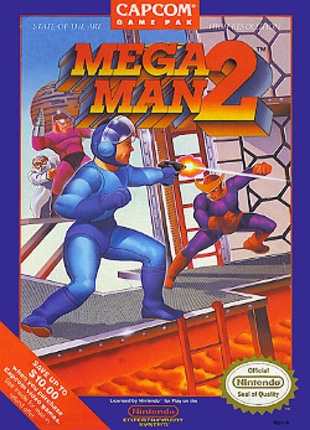
You probably remember the box before you remember the game. A blocky, faintly muscular Mega Man crouched behind a rock, gripping a handgun that never once appears in the actual cartridge. Capcom’s Japanese marketing had Rockman as a clean, friendly cartoon hero. Capcom’s American marketing gave him a pistol and a scowl he doesn’t own. It’s one of the most mocked pieces of box art in NES history, and it sits on top of one of the best games the console ever produced.
Mega Man 2 hit Japanese Famicom shelves in December 1988 and reached North America in June 1989, developed and published by Capcom for the NES (details corroborated on Wikipedia). That timeline almost didn’t happen. The original Mega Man sold modestly enough that a sequel wasn’t a given, and director Akira Kitamura had to convince Capcom’s own vice president to greenlight one. The team ended up building it on the side, around their other assigned projects, in roughly three to four months. Keiji Inafune, who worked on character design, later described it as some of the most fulfilling work of his career, the rare project where the team was simply making the game they wanted to make.
That scrappy production schedule produced something tighter and smarter than its predecessor. Eight Robot Masters, each with a signature weapon and a rock-paper-scissors weakness chain, gave players a real strategic puzzle in what order to fight them. Energy Tanks let you bank health for later boss fights instead of restarting from zero. A password system meant you didn’t have to burn through all eight stages in one sitting, which mattered on a console with no built-in save battery in most cartridges. None of these ideas were entirely new to gaming, but Mega Man 2 assembled them into a shape the series would follow for the next three decades.
Then there’s the music. Composer Takashi Tateishi, pulling influence from fusion acts like Mezzoforte and synth-pop pioneers Yellow Magic Orchestra, wrote a soundtrack that outgrew the game itself. The Dr. Wily stage theme alone has been remixed, covered, and sampled more times than most console games manage across their entire catalog. Ask a room of collectors to hum an NES tune from memory and there’s a decent chance more than one of them lands on this one.
Reviewers noticed the improvement immediately. Electronic Gaming Monthly’s panel scored it 8 out of 10 across the board, praising the sharper visuals and more forgiving difficulty curve compared to the brutal original. Mean Machines went as high as 95 percent. It went on to sell more than 1.51 million copies worldwide, a number that held as the series’ commercial peak for roughly three decades until Mega Man 11 finally passed it in 2019.
The gun on the cover, as it turns out, wasn’t malice. Artist Marc Ericksen has said in later interviews that he simply wasn’t given clear reference material for what Mega Man’s Buster cannon looked like, so he improvised. That mismatch between the West’s marketing instincts and Japan’s actual character design shows up more than once in Capcom’s early NES output. We covered a similar case with the original Mega Man’s cover in our piece on Super Mario Bros. vs. Mega Man, and the sequel somehow didn’t learn the lesson.
For collectors, that infamous cover is part of the appeal now rather than a liability. A complete-in-box copy with a crisp, uncreased “gun Mega Man” cover and intact cardboard tray holds up well against other mid-run Capcom NES titles, and buyers checking a listing should look closely at corner wear and box seam splits before trusting a seller’s condition claim. If you’re ever unsure what you’re actually holding, that’s exactly the kind of thing worth having verified rather than guessed at — see how our grading process works.
Mega Man 2 is the rare sequel that fixed nearly everything wrong with its predecessor while keeping what worked, then wrapped the whole thing in cover art that became a joke almost immediately. Thirty-some years later, people still buy the game for the soundtrack and keep the box for the punchline.