

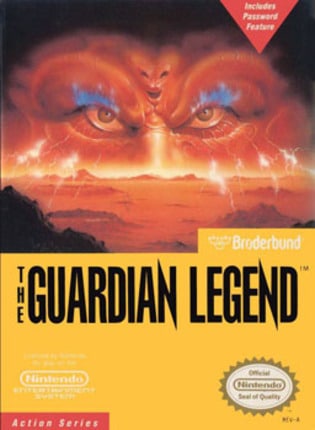
Rent this one blind from the video store in 1989, and you had no idea what you were about to load. The box showed a lone woman standing in front of a burning space station, laser cannon raised. Pop the cartridge in and the first twenty minutes look like a smaller, tighter Zelda-style adventure: walk an open map, fight enemies from a top-down view, find a key, unlock a door. Then a corridor opens up, the screen starts scrolling, and that same character turns into a starfighter dodging bullet patterns straight out of an arcade shooter. The Guardian Legend never picked a genre. Nearly forty years later, that indecision is exactly why it’s worth a second look.
Compile built it — the same Japanese studio that would go on to create Puyo Puyo — under director Masamitsu Niitani. It shipped in Japan on February 5, 1988 as Guardic Gaiden, published by Irem as a sequel to the 1986 MSX game Guardic. Broderbund brought it to North America in April 1989 under the title everyone knows it by now, and Nintendo handled the European release the following year.
The hybrid structure is the whole pitch. “Labyrinth” sections play like an overhead adventure game: explore, collect items, find the boss key, move on. “Dungeon” sections drop the exploration entirely and turn the game into a forced-scrolling shooter, weapons upgrading as you rack up points, closer in spirit to 1942 than to anything else Nintendo was publishing that year. Your character — part android, part starfighter — physically transforms to move between the two halves. That’s a strange thing to pull off convincingly on 1988 hardware, and it mostly works.
The cover art, painted by Naoyuki Kato, gives the guardian a distinct human face that the blocky in-game sprite never really commits to. It’s a mismatch between box and cartridge that collectors of this era run into constantly — Mega Man 2’s gun-toting hero is the most famous local example, but The Guardian Legend was pulling the same trick a year earlier.
Reception was split when it mattered. Electronic Gaming Monthly’s four-reviewer crew handed out scores of 6, 5, 6, and 7 out of 10 — solid, not glowing. Nintendo Power thought more of it, ranking the game ninth on its September 1989 Top 30 and nominating it for reader awards that year. Decades later, IGN’s 2009 retrospective called it one of the more influential games of its console generation, a reappraisal detailed on the game’s Wikipedia page. The complaints that show up in nearly every review, old and new, stay consistent: the shooter stages repeat their patterns more than they should, and the game saves progress through a password instead of a battery — a string of letters and numbers you copied onto paper by hand.
That password system, annoying as it was in 1989, is a small gift to collectors now. A cartridge with no coin-cell battery inside can’t develop the corroded board and dead-save problems we’ve covered before in Game Boy carts. What actually determines value on a Guardian Legend copy is the box and manual, specifically the fold-out password reference Broderbund printed inside, which a lot of rental-shop copies never had to begin with and a lot of loose carts on the market today are missing. A genuinely complete-in-box copy, chart included, is scarcer than the game’s reputation as a forgotten rental title would suggest — exactly the kind of detail our grading process is built to catch.
If you’ve never played it, it’s worth tracking down before you go chasing anything rarer. It’s a strange, ambitious swing from a small team still years away from its most famous creation, and it holds up better than most 1989 genre experiments have any right to.