

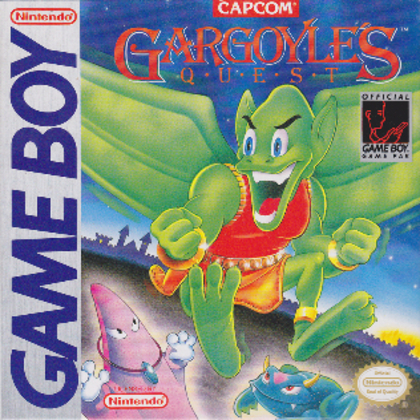
Firebrand was never supposed to be a star. In the original Ghosts ‘n Goblins, he’s a tiny red gargoyle who swoops down at Arthur’s head for about half a second before a well-timed lance ends him. He’s scenery with wings. So it says something about Capcom’s confidence in 1990 that they built an entire Game Boy game around that throwaway enemy — and that the result held up well enough to still show up on best-of-Game-Boy lists more than three decades later.
Gargoyle’s Quest launched in Japan on May 2, 1990, with a North American release that July. The premise flips the Ghosts ‘n Goblins formula: Firebrand is the hero now, a gargoyle destined to become the Red Blaze and defend the Ghoul Realm from an invading king named Breager. It is still a Capcom action game at heart, full of demons, castles, and unforgiving platforming. But the structure is the surprise. Players move between an overhead map, picking routes and side quests, then drop into side-scrolling stages to fight through them. Firebrand can walk, jump, cling to walls, and hover for short bursts, and he gains new abilities as the adventure continues. It plays less like a straight platformer and more like an early sketch of the Metroidvania structure that wouldn’t become a genre name for another few years.
Critics noticed immediately. GamePro predicted the game would be “a system seller.” Nintendo Life’s retrospective review landed at 9 out of 10, and Game Informer later ranked it 18th among the best Game Boy games ever made. That is rarefied company for a handheld whose library runs into the hundreds. And yet ask a casual retro fan to name a great Game Boy game and you’ll hear Tetris, Link’s Awakening, maybe Pokémon — almost never Gargoyle’s Quest. It sits in the same blind spot as Kid Icarus: Of Myths and Monsters, a sequel that landed on the same system and got buried by bigger names anyway.
Part of that is sequencing. Gargoyle’s Quest spawned a prequel, Gargoyle’s Quest II, on NES in 1992, and then a true sequel, Demon’s Crest, on Super NES in 1994. Most players who know the series at all came in through Demon’s Crest, with its sharper visuals and bigger budget, and never circled back to the Game Boy original that started it. The trilogy rewards playing in release order about as often as it gets played that way, which is to say almost never.
None of that has made original copies especially hard to find. Gargoyle’s Quest doesn’t carry the four-figure price tags attached to the genuine Game Boy grails — the Japan-only and PAL-exclusive titles that never got a North American release at all. But a complete-in-box copy with a crisp label, intact manual, and a cartridge that hasn’t spent twenty years in a humid closet is worth more than people expect from a launch-window Capcom game, especially as graded early Game Boy titles get more attention from collectors tracking the system’s first couple of years on shelves.
Firebrand eventually got his flowers. It just took the rest of the gaming world a while to notice that the little gargoyle who used to die in one hit from Arthur’s lance was carrying one of the better games on the system the whole time.