

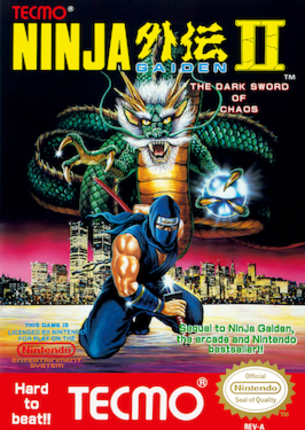
You finally beat the first Ninja Gaiden. You watched the ending, you earned the bragging rights, and you figured Ryu Hayabusa’s story was over. Then a friend mentioned there was a sequel already on shelves, and it was supposedly even tougher. That’s the kind of news that could ruin a kid’s whole week in 1990.
Tecmo released Ninja Gaiden II: The Dark Sword of Chaos in Japan on April 6, 1990, with the North American NES version following that May. It picked up the story one year after the original, with a new villain named Ashtar scheming to unleash a cursed blade called the Dark Sword of Chaos. Ryu gets pulled back in when his ally Irene Lew is kidnapped, and the plot escalates from there through more of the cinematic cutscenes that made the first game feel like a movie squeezed onto a cartridge.
The sequel’s real claim to fame is a gameplay trick nobody asked for and everybody remembers. Collect the right item mid-level and Ryu splits into two. A translucent orange clone trails behind him, copying every jump and every sword swing in perfect sync. It sounds like a glitch. It’s actually the mechanic Tecmo built the whole back half of the game around, letting players double their damage on bosses at the cost of making an already unforgiving game feel almost fair for a few seconds at a time. Ryu also gained the ability to climb walls freely in this entry, something the original game never let him do.
Critics noticed the upgrade immediately. Electronic Gaming Monthly put it on the cover as Game of the Month and called the graphics, difficulty, and story “near-perfect,” while Nintendo Power had the game debut at number four on its Top 30 chart that fall. It picked up five nominations at the magazine’s 1990 awards, covering everything from Best Hero to Best Overall, though it didn’t take home a trophy in any category. The slight came out even by 1997, when EGM’s 100 Best Games list ranked it 88th and called it flatly “the best” of the three NES Ninja Gaiden games. GamesRadar agreed enough to slot it at number 20 on its own best-of-NES ranking in 2012.
Reviewers did knock one thing: the story. Where the original’s twist ending felt genuinely surprising for an 8-bit game, this one leaned on a more predictable “stop the evil emperor” setup, and later writeups noted the cutscenes themselves felt a touch more generic the second time through. None of that stopped the game from getting re-released again and again, most recently landing on PlayStation 5 and Switch 2 through Hamster’s Console Archives series in February 2026, nearly thirty-six years after it first hit store shelves.
That long re-release history is part of why the original cartridge still matters to collectors. A digital re-release doesn’t carry the cardboard box art of Ryu mid-leap, and it definitely doesn’t carry the label wear and box creasing that separate a beat-up loose cartridge from a pristine complete-in-box copy. If you’ve already read our Ninja Gaiden Game Spotlight, this one fills in the other half of the trilogy’s opening chapter, and it’s worth a look in our gallery of graded games to see how much condition alone can swing what a sequel like this is worth next to its more famous predecessor.
Thirty-six years later, the hardest part of Ninja Gaiden II still isn’t the final boss. It’s convincing yourself that cloning Ryu wasn’t cheating.