

Pop Kung Fu into an NES in October 1985 and you got a guy named Thomas punching his way up five floors of a temple to rescue a woman named Sylvia from a crime boss called Mr. X. What almost nobody playing it realized was that Thomas was named directly after Jackie Chan’s character in the 1984 film Wheels on Meals, and the whole game was a loose video-game adaptation of it. Nintendo never advertised that connection in North America. The movie tie-in got quietly scrubbed somewhere between Irem’s Japanese arcade cabinet and the cartridge in your living room.
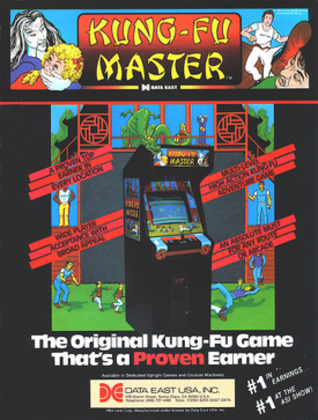
The arcade original came from Irem, released in Japan as Spartan X in November 1984 and brought to the US by Data East as Kung-Fu Master that March. It also pulled from Bruce Lee’s Game of Death, borrowing that film’s floor-by-floor pagoda structure and giving each level its own boss. Nintendo licensed it, and the Famicom conversion landed in Japan that June under its original Spartan X name before crossing the Pacific as plain old Kung Fu.
The team behind that conversion is the real story here. Shigeru Miyamoto directed and designed the port, Koji Kondo built the sound effects, and Toshihiko Nakagou handled the programming. Miyamoto reportedly wanted the side-scrolling experience for its own sake. He got it, and less than a year later he used what he’d learned to build Super Mario Bros. The résumé line connects two of the most important games the NES ever ran, and almost nobody clocks it.
Kung Fu wasn’t a small seller riding on that pedigree, either. The NES version moved roughly 3.5 million copies worldwide, and in the US it was the best-selling video game in the country in both July and September of 1986, a full year after launch. Reviewers at the time agreed it held up: Computer and Video Games called it a near-perfect conversion with every level and mechanic intact, and decades later IGN still ranked it 62nd on its list of the top 100 NES games, dinging it as a “dumbed-down port” of the arcade while admitting the boss fights still make you earn every floor.
Those boss fights are worth dwelling on. Each one strips away the scrolling and turns into a straight one-on-one duel, timer running, health bars on both sides. It’s a small, almost throwaway idea in a 1985 action game, but you can trace a line from it to the combat system Nintendo built two years later for Zelda II’s side-view sword fights, where positioning and timing suddenly mattered more than just mashing a button.
Collectors tend to lump Kung Fu in with the NES’s earliest wave almost automatically, and that’s accurate: it’s part of the same launch-era black box lineup as Super Mario Bros. and Duck Hunt, a run of titles we broke down in our ranking of the ten best NES Black Box games. Black box cartridges get a disproportionate amount of collector attention precisely because they’re the games that were actually in the box with the console, or sitting on shelves the week the NES launched in a given region, and that early-production status shows up in what graded copies command. If you’re trying to figure out where a copy of yours might land, our gallery of graded video games is a reasonable place to start comparing.
Kung Fu never got the sequel treatment in the US. A 1991 Famicom follow-up, Spartan X 2, was planned for a North American release as Kung Fu II and simply never shipped here. Which means the entire story of this one, outside Japan, is one cartridge: a disguised Jackie Chan game that quietly taught Nintendo’s own in-house legend how to scroll.