

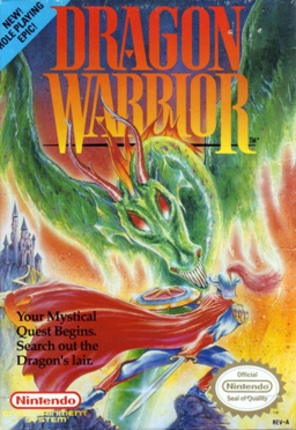
A lot of kids got their first NES role-playing game because a Nintendo Power renewal notice showed up with a padded envelope stapled to it. No launch-day line, no ad blitz. Just a magazine subscription that suddenly came with a free cartridge inside, and that cartridge was Dragon Warrior.
It wasn’t new when it landed in American mailboxes. Dragon Warrior is the American localization of Dragon Quest, a game Chunsoft built and Enix published in Japan back in May 1986, created by Yuji Horii. Nintendo of America didn’t bring it stateside until August 1989, more than three years after Japanese kids were already grinding slimes on the Famicom. That gap mattered. A game built for 1986 audiences had to compete with 1989 NES shelves already packed with Mega Man 2 and Ninja Gaiden.
Localizing it meant more than translation. Nintendo swapped the Dragon Quest name because a tabletop RPG called DragonQuest already existed. Password saves became battery backup. The hero’s sprite got redrawn to actually face the direction it walked. Dialogue turned into pseudo-Elizabethan English, so a scratch from a slime reads as “Thy hit points have decreased by 1.” Nintendo also scrubbed the game’s Japanese religious references and turned an adult-flavored bathhouse gag into a scene about buying tomatoes.
None of that saved it commercially, at least not right away. Nintendo executive Howard Phillips later said the game tested poorly because the action felt thin and the graphics looked dated next to what NES owners expected by 1989. Nintendo had printed roughly a million cartridges and sold only about half of them through normal retail.
So Nintendo tried something else. Late in 1990, it offered Dragon Warrior free to anyone who subscribed to Nintendo Power, a cartridge worth roughly fifty dollars bundled into a twenty-dollar subscription. The response buried the warehouse. Workers reportedly processed seventy thousand units an hour across several nineteen-hour shifts just to keep up. The promotion pulled in close to five hundred thousand new subscribers and quietly cleared out Nintendo’s surplus in one move.
That giveaway is also why the game barely shows up on grading want lists today. Most surviving copies came bundled with a specific Nintendo Power mailer, not sold individually off a store shelf, so a true complete-in-box retail copy with its original packaging is scarcer than the sales numbers suggest. Collectors chasing an early box art variant should check the fine print on what actually shipped in that envelope before assuming any Dragon Warrior copy is interchangeable with another. That’s the kind of detail grading exists to sort out.
The commercial stumble didn’t kill the idea behind it. Dragon Warrior proved American kids would play a turn-based RPG if the interface stayed simple enough, and that groundwork is part of why Final Fantasy found an audience willing to try something similar just a year later. Horii’s slime-fighting hero never became a Western household name the way Mario or Link did. But he opened a door that Square, and eventually most of the genre, walked straight through.