

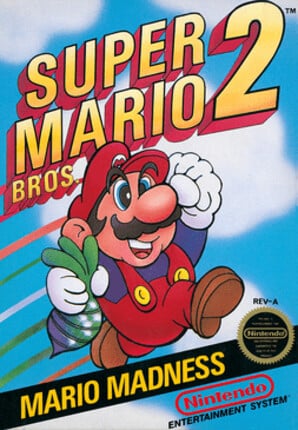
You pull a radish out of the ground and throw it at a mask-wearing creature spitting fireballs at you. There is no jumping on anyone’s head. Princess Peach is playable, and she floats like she’s got a parachute stapled to her dress. If you grew up thinking this was just how a Mario sequel worked, you were never told the truth: Nintendo built this game out of spare parts from something else entirely.
The real sequel already existed. Japan got its own Super Mario Bros. 2 in 1986, a brutal, trap-laden remix of the original built for players who’d already mastered it. Nintendo of America looked at that game and made a call: too similar, too punishing, not what this market needed. So they went looking for a replacement, and they found one in the strangest possible place.
That replacement was Yume Kōjō: Doki Doki Panic, a game built as an advertisement for a Fuji Television expo called Yume Kōjō ’87 — “Dream Factory ’87.” It had nothing to do with Mario. It had its own cast, its own vegetable-yanking mechanic, its own two-player twist where one character could ride the other’s shoulders. Nintendo swapped in Mario, Luigi, Toad, and Peach for the original cast, adjusted the enemies, and shipped it to America on October 9, 1988, as Super Mario Bros. 2. Most players had no idea any of this happened until decades later.
Whatever you want to call the swap, it worked. The game topped U.S. sales charts for 14 straight months. It sold roughly 3.5 million copies domestically by early 1990 and 7.46 million worldwide, making it the fourth best-selling game on the entire NES library — and the best-selling one that wasn’t bundled in a box with the console itself. People weren’t getting this one for free with a Zapper. They were buying it on its own merits.
Those merits held up. Four playable characters, each handling differently, was a genuinely new idea for a console platformer in 1988. Toad hits like a truck and moves fast. Luigi jumps higher than physics should allow. Peach floats. Mario just does everything adequately, which is its own kind of lesson for a kid learning that balance beats specialization. None of them can stomp an enemy to defeat it, which broke the one rule every Mario Bros. player already knew cold. You pick things up instead. You throw them. Sometimes you throw the enemies themselves.
Then there’s the ending, which nobody warns you about before you get there: the whole adventure through the dream-world of Subcon turns out to be exactly that, a dream, with Mario waking up in his own bed. It’s a strange note to close on, and it stuck around because of how confidently the game commits to it. So did one of the cast members recruited from Doki Doki Panic — the egg-spitting dinosaur Birdo, who went from one-off boss to a Mario Kart and Mario Party regular that’s outlasted plenty of games that were more “canonical” from the start.
We already dug into how touchy Nintendo got about a different piece of box art in our Super Mario Bros. vs. Mega Man breakdown, and this one’s box tells its own quiet story. Because it sold so well as a standalone purchase rather than a pack-in, far more complete copies survived than you’d expect for an ’80s NES title — but that doesn’t mean condition stopped mattering. A cartridge that spent three decades getting shoved into a shared bedroom shelf shows it, and the gap between a well-loved copy and a genuinely high-grade one is still wide enough to matter to anyone building a serious collection. If you’ve got one sitting in a drawer and you’re curious where it actually lands, that’s exactly what our grading process is built to sort out.
Forty years on, most people who play a game with a playable Peach or a stat-balanced default character have no idea they’re standing on ground this one broke first. It just took a rebranded festival mascot game to get there.