

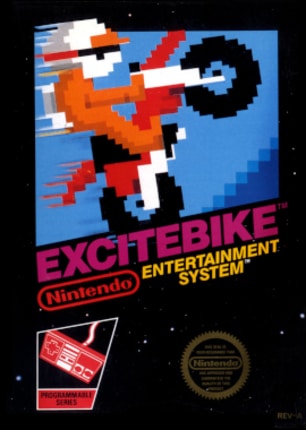
You spent an hour building the perfect Excitebike track. Every jump timed so a turbo boost landed you square in the middle of the next straightaway, every log placed to punish anyone who didn’t respect the overheat gauge. Then you turned off the NES to go to dinner, and it was gone. Not saved anywhere. Just gone, the way a sandcastle is gone at high tide.
That wasn’t a bug. It was the North American release working exactly as designed, and it’s the detail that makes Excitebike a stranger game than most people remember.
Nintendo released Excitebike in Japan in November 1984 and brought it to the United States in October 1985, right in the thick of the NES’s launch window. It shipped in the Black Box packaging that also carried Duck Hunt, Ice Climber, and Kung Fu, and it sold well enough to become one of the best-selling games on the console — Nintendo’s own shipment figures put it north of four million units. It was directed by Shigeru Miyamoto, fresh off Donkey Kong and about to start work on Super Mario Bros., with Toshihiko Nakago handling the programming.
That last detail matters more than it looks. The smooth, momentum-based side-scrolling engine Nakago and the team built for Excitebike, where the racer accelerates gradually instead of snapping straight to top speed, got reused almost wholesale for Mario. Before Excitebike, most side-scrollers moved characters at a fixed speed or not at all. After it, Mario could ease into a run and skid to a stop, and that engine is a direct ancestor of it.
The game itself is simple on paper. You race a motocross bike over hills and hurdles, hold down the accelerator, and tap a turbo button that gives you a burst of speed at the cost of overheating your engine if you lean on it too long. Push the turbo through a stretch of rough track and you’ll blow past three rivals. Push it a beat too long and you’re watching smoke pour out of your engine while everyone passes you back. It’s a risk-reward loop that still holds up, which is part of why IGN ranked it 14th on its list of the best NES games ever made.
Then there’s Design Mode, the track editor tucked into the game’s second half. Players could lay out their own courses using nineteen different hurdle types and, in Japan, save them to a Famicom Data Recorder cassette. American cartridges kept the editor but dropped any way to save what you built, since the Data Recorder never made it to the U.S. market. So the mode that should have been the game’s biggest selling point turned into something closer to a private performance. You built something, you rode it, and then it evaporated the moment the console powered down.
It’s an odd thing for a game this well-known to have gone this long without its own spotlight here. Excitebike has shown up twice already, first on our ranking of the ten best NES Black Box games, and again on our list of the console’s best sellers, but always as a name in someone else’s list rather than the main event.
For collectors, Excitebike sits in an interesting spot. It’s common enough in loose form that most graders see it constantly, but a genuinely clean Black Box copy with sharp corners and an intact seal is scarcer than the sales numbers would suggest, since so many copies spent the eighties getting stacked, sat on, and shipped between siblings’ bedrooms. Condition, as always with this era, is where the real story lives.