
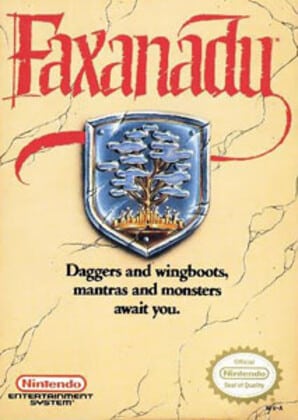
You rented it because the box looked like nothing else on the Blockbuster shelf. A knight standing in front of a tower under a green sky, no Nintendo mascot in sight, no recognizable license. You had no idea what “Faxanadu” even meant. Neither did most of the kids who took it home in 1989.
Here’s the answer, decades late: it’s a portmanteau. Hudson Soft built the game as a spin-off of Falcom’s PC game Xanadu, itself the second entry in the Dragon Slayer series, and ported the concept to the Famicom — so “Famicom” plus “Xanadu” became Faxanadu. Japan got it first, in November 1987. Nintendo brought it to North America in August 1989, publishing it directly under license from Hudson Soft rather than treating it as a straightforward Western port.
What made it stand out wasn’t the name. It was the structure. Faxanadu drops you into a side-scrolling world built more like a vertical tower than a flat map, climbing through a corrupted kingdom while fighting off enemies with a sword, buying armor and magic from townsfolk, and gradually opening up new paths as your equipment improves. Call it an action RPG, call it an early platformer-metroidvania hybrid — reviewers have used both labels over the years, and both are basically right. It landed in the same NES window as Zelda II and the original Dragon Warrior, part of a brief run where Nintendo let Japanese RPG structures loose on American kids who’d mostly grown up on Mario and Mega Man.
The soundtrack deserves its own mention. Composer Jun Chikuma, working with sound programmer Toshiaki Takimoto, pulled jazz chord voicings out of the NES’s three-channel sound chip — not the easiest instrument to bend that way. It’s one of the more distinctive NES scores precisely because it doesn’t sound like it’s trying to be epic. It sounds like it’s trying to be interesting.
Faxanadu never became a franchise face the way Zelda or Mega Man did, but it picked up real respect over time. IGN revisited it in 2011 and gave it an 8.5 out of 10, calling it a hidden gem and arguing it held up better than Zelda II or Castlevania II. Retro Gamer later ranked it 16th on a list of the best NES games ever made. Nintendo Life scored it 8 out of 10 and singled out one real flaw: the password save system, which demands you copy down a long string of characters every time you want to stop playing. No battery save, no forgiveness. If you lost the scrap of paper, you started over.
It also got a strange little pop-culture footnote. In 1990, Faxanadu showed up in two episodes of the Captain N: The Game Master cartoon, complete with an Elven King modeled — unmistakably — on Elvis Presley. Nobody asked for that. It happened anyway.
Collectors have caught up to what the critics eventually figured out. A complete-in-box Faxanadu isn’t rare in the way something like Little Samson is, but clean box copies still move for real money, partly because that thin cardboard box wasn’t built to survive three decades of shelf life. Corner wear, spine crushing, and sun-faded artwork are the usual suspects graders flag when a “complete” copy turns out to be anything but.
If you’ve spent time with Zelda II, Faxanadu is worth tracking down as the stranger cousin nobody talks about at family gatherings — same era, same experimental itch to bend an action game into something with stats and story, same NES trying to figure out what an RPG was even supposed to look like on a console. (More on the game’s history at Wikipedia.)