

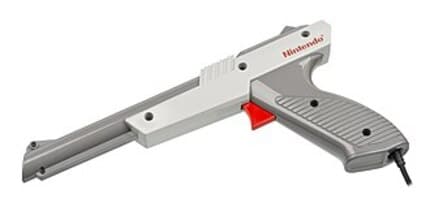
Every NES household had a version of the same afternoon: someone pointing a plastic ray gun at the television, half-convinced the dog on screen was mocking them personally. That gun was the Zapper, and it’s one of the strangest success stories in Nintendo’s history. It sold in the millions, taught an entire generation how a light gun works without anyone actually knowing how it worked, and then quietly became obsolete the moment flat-screen TVs took over living rooms.
Nintendo of America launched the Zapper alongside the NES itself, debuting in the New York test market on October 18, 1985. It wasn’t an original design. The internals came from Gunpei Yokoi’s Video Shooting Series light gun, released in Japan for the Famicom in February 1984 and shaped like an actual revolver. Nintendo of America’s head designer, Lance Barr, reskinned it into something less likely to alarm parents: a boxy, gray “ray gun” with rounded edges that looked like it belonged on a sci-fi show rather than in a holster.
The trick behind it was simpler than it looked. Pull the trigger, and the game briefly flashes the entire screen black, then flashes valid targets in solid white on the very next frame. A photodiode in the Zapper’s barrel reads that flash and reports back whether the gun was pointed at a lit target when it happened. It’s an elegant workaround for hardware with no real aiming logic, and it’s also the reason the Zapper is functionally dead weight on a modern television. LCD and plasma screens introduce enough processing lag that the sensor can’t catch the flash in time, so the gun simply stops registering hits. A CRT television isn’t nostalgia here; it’s the only thing that actually makes the accessory work.
The original Deluxe Set, which arrived in mid-1986, paired the Zapper with two controllers, R.O.B., and a cartridge holding Gyromite and Duck Hunt — still the best-selling Zapper game by a wide margin. Wild Gunman, Hogan’s Alley, and later Gumshoe filled out the light gun library, but Duck Hunt was the one that actually got the Zapper into people’s hands.
The Zapper’s most visible change had nothing to do with performance. By 1988, growing public alarm over toy guns that looked too real — fueled by news coverage of police mistaking realistic replicas for actual firearms — pushed Nintendo to swap the original’s gray-and-black finish for a bright orange one, a color chosen specifically so the thing was unmistakable as a toy from across a room. The orange Zapper is the version most people picture today, and it’s the one Nintendo kept referencing decades later: the N-ZAP weapons in Splatoon are a direct nod to both the gray ’85 model and the orange ’89 revision. Nintendo pulled the Zapper from shelves for good on October 21, 1998, closing out a thirteen-year run.
For collectors, that orange plastic has aged into its own small headache. It yellows with UV exposure the same way old Game Boy shells do, and a Zapper that’s browned or blotchy reads very differently to a grader than one that’s held its factory color. Add in a two-piece shell that’s easy to crack at the trigger guard, and a complete, well-preserved Zapper in its original box is a lot less common than the sales numbers would suggest. If you’re trying to figure out what condition actually means for a piece like this before sending it in, our grading process breaks down exactly what we’re looking for.