

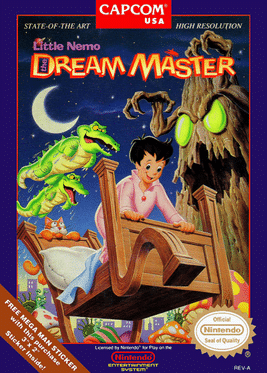
Rent this one from the video store in 1990 and you had no idea what you were getting into. The box art showed a kid in pajamas riding a frog. The game inside made you feed candy to enemies so you could climb inside them and use their powers to get past a locked door. Nobody explained any of that up front. You just figured it out, level by level, usually while getting stomped by something you hadn’t fed candy to yet.
Little Nemo: The Dream Master is Capcom’s 1990 NES platformer, and it deserves more attention than it gets. Nemo can’t fight back directly. Instead he tosses candy dust at enemies to put them to sleep, then climbs inside and rides them: a frog for big jumps, a bee for flight, a mole for tunneling through walls. Each animal is required to clear specific obstacles, so half the game is figuring out which creature unlocks which door. Three years later, Kirby’s Adventure built its entire ability-copying system on a nearly identical idea, though nobody seems to give Nemo credit for getting there first.
Reviewers liked it a lot more than most players remember. GamePro gave it a 23 out of 25. French magazine Player One scored it 92 percent. Electronic Gaming Monthly’s four reviewers landed at 7, 8, 7, and 9 out of 10. IGN later ranked it #68 on its 2009 list of the top 100 NES games of all time. None of that changes the fact that it’s brutally hard. Modern retrospectives still describe it as “punishingly difficult,” and anyone who’s tried to clear the ice levels without over-leveling their candy supply knows exactly why.
The stranger story is the movie behind it. Little Nemo: Adventures in Slumberland spent roughly a decade in development hell before it ever reached a theater. Producer Yutaka Fujioka started chasing the rights in 1977. Ray Bradbury wrote an early draft of the screenplay. A young Hayao Miyazaki pitched story concepts before walking off the project in 1982, frustrated with where it was headed — ideas he later folded into Nausicaä and Princess Mononoke. Isao Takahata took a turn next and lasted about four months before he left too. John Lasseter and Brad Bird stopped by at various points. By the time Masami Hata and William Hurtz finally got a finished film into Japanese theaters in July 1989, it had eaten through a $35 million budget against a $11.4 million Japanese box office — a flop by any measure, even with Disney veterans Frank Thomas and Ollie Johnston brought in to consult.
Here’s the part that makes the NES game an actual oddity: Capcom released it in North America in September 1990, nearly two full years before the movie itself opened in American theaters. Slumberland didn’t get a proper U.S. release until August 1992, trimmed for a G rating. American kids were riding pajama-clad Nemo through candy-powered platforming levels years before they could see the film that supposedly inspired it. The movie eventually found its audience on VHS instead, becoming the fourth best-selling kids’ video of 1993 with 1.5 million copies sold — a quieter, delayed version of the success the theatrical run never had.
None of that history shows up anywhere on the cartridge or in the manual. It’s just a Capcom logo, a kid, and a frog. That’s part of what makes Little Nemo worth a second look for collectors, too — it’s the kind of title that gets overshadowed by the same publisher’s bigger Capcom names on the NES, which tends to keep complete-in-box copies more affordable than the difficulty and review scores would suggest. If you’ve got one sitting in a drawer, checking its condition before you assume it’s just a $10 loose cart is worth the five minutes — a clean box and manual change the math considerably. Our grading process walks through what we’re actually looking for.