

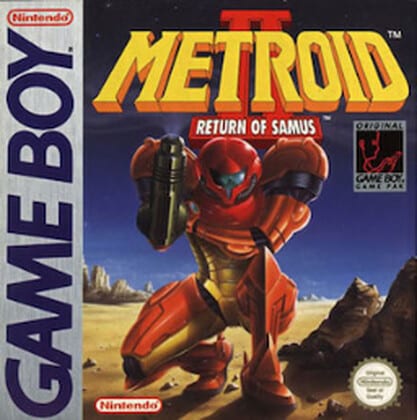
Picture a kid in the back seat of a station wagon in November 1991, gray brick of a Game Boy held two inches from his face, thumb sore from the jump button. He is not fighting a dragon or a soldier. He is hunting something that looks like a leech the size of a dog, on a planet with a name that sounds like a car part. That kid had no idea he was watching Nintendo quietly redesign one of its most famous characters for good.
Metroid II: Return of Samus landed on Game Boy that November, developed in-house by Nintendo R&D1 as the direct follow-up to the 1986 NES original. The mission was simple on paper and brutal in practice: wipe out every Metroid on the planet SR388, all 47 of them, spread across five evolutionary stages that get meaner as you go. First you meet the standard Metroid form, then Alpha, then Gamma, then Zeta, then finally the towering Omega. Each stage demands a different strategy, and the game keeps count for you, so there is no ambiguity about whether the job is finished.
The new toolkit is where this entry earns its reputation. Samus picks up the Spazer Laser and the Plasma Beam, gains the Space Jump for endless mid-air hops, and adds the Spider Ball and Spring Ball to the Morph Ball repertoire. Save modules replace the password system, a small change that made the whole adventure feel less like homework between play sessions.
Here is the detail collectors and grading nerds love to bring up: the Game Boy’s four-shade gray screen made Samus’s original Metroid armor hard to read at a glance. Nintendo’s artists solved it by giving the Varia Suit rounded metal shoulder pads for extra contrast. That single readability fix stuck around. Every Metroid game since has kept those shoulders, all because of a handheld screen that could not render subtle color detail. Even the planet’s name has a small, odd story behind it — SR388 is reportedly a nod to the Yamaha SR400 motorcycle, a bit of trivia that has floated around Metroid fan circles for years.
Reviews at the time were mixed. Some critics liked the sprite work and animation, others thought the graphics looked flat for a 1991 handheld release, and the music took the brunt of the criticism from nearly everyone. History has been kinder. Retrospective writeups point to tight, responsive controls and exploration areas noticeably larger than the NES game, though critic Jeremy Parish has argued the zoomed-in camera made jumping and ranged combat awkward on a screen this small. Commercially, it held up fine, moving an estimated 1.72 million copies worldwide by late 2003, and Nintendo Power ranked it 34th on its 1997 list of the 100 best games ever made. The ending, where a newly hatched baby Metroid imprints on Samus instead of attacking her, set up the entire plot of Super Metroid two years later.
If you want the game that started the hunt in the first place, we already covered how the original NES Metroid turned getting lost into the whole point. Boxed, complete copies of the Game Boy sequel are tougher to find in top shape than you might expect — that cardboard box was never built to survive thirty-five years of basements and moving trucks. If you are holding one and wondering what condition actually does to its value, that is exactly the kind of question our grading process is built to answer.
Not bad for a gray cartridge that made a kid in a station wagon miss his exit.