

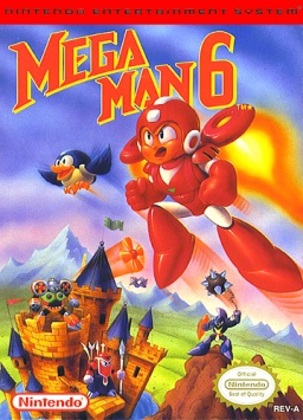
You find it on the shelf in early 1994, tucked between the SNES titles that are starting to take over the end caps. Same blue armor. Same number on the cartridge. But something’s off: the box doesn’t say Capcom across the top anymore. It says Nintendo. For a kid who’d bought five of these games in a row from the same publisher, that swap was the first hint that the NES was running out the clock.
Mega Man 6 is Capcom’s work from start to finish. The company built it, Capcom released it in Japan in late 1993, and then handed the North American release to Nintendo rather than put its own name on the box here. The NES was on its way out, the Super NES was the console everyone wanted, and Capcom had apparently decided a sixth NES sequel wasn’t worth the marketing push under its own banner. Nintendo picked it up and shipped it in March 1994, making it the last original Mega Man game to appear on the console that made the Blue Bomber a star.
That swap in publishers is the kind of detail that gets lost once a game turns thirty, but it tells you exactly where the NES stood in its final year. Late-era NES titles like this one didn’t get the print runs that Super Mario Bros. or the early Mega Man games enjoyed, and that scarcity is part of why complete, well-preserved copies of Mega Man 6 carry real weight with collectors today. Fewer copies made, fewer still that survived in shelf condition.
The game itself didn’t coast on the series’ reputation. Mega Man 6 introduced the Rush Adaptors, a pair of transformations built around Mega Man’s robot dog that changed how players approached each stage. Jet Mega Man traded the charge shot for the ability to fly or hover for a few seconds, letting players skip hazards that would otherwise require pixel-perfect jumps. Power Mega Man gave up mobility for a short-range punch that could flatten enemies and break through blocks the standard Buster couldn’t touch. Pair either adaptor with the right Robot Master weapon and whole stages opened up differently than a first-time player would expect.
Capcom also split most stages into two branching paths this time, so beating a level meant choosing a route rather than following one fixed line to the boss door. Collect four letter circuit boards hidden across those stages and you could assemble Beat, the helper bird who’d first shown up as a reward item and now worked more like a real support mechanic, diving in to peck at enemies on command.
Six of the eight Robot Masters bosses this time came from a Japanese design contest, the same kind of fan pipeline Capcom had leaned on before. The other two, Knight Man and Wind Man, were designed by North American kids who entered through Nintendo Power. It’s a small credit line, but it means two of the robots a generation of American players fought through were dreamed up by other American players first.
Reviewers at the time landed somewhere in the middle. Electronic Gaming Monthly’s panel gave it a run of 6s and 7s, solid but hardly a rave, and some outlets openly wondered how many more times Capcom could run this formula before it wore through completely. Nintendo Power was more generous, praising it as one of the strongest NES releases of that year. Looking back, that split reads less like disagreement and more like two different audiences: critics tired of yearly sequels, and players who were about to lose the console these games were built for and wanted one more trip through it.
If you’re chasing a complete-in-box copy now, the hunt is part of the appeal. A clean Mega Man 6 cartridge with its manual and the original Nintendo-branded packaging intact is a different animal from a loose cart pulled out of a bargain bin, and knowing which is which matters whether you’re buying, selling, or just trying to figure out what’s sitting in your own closet. That’s the kind of condition call a graded, authenticated copy settles for good.