

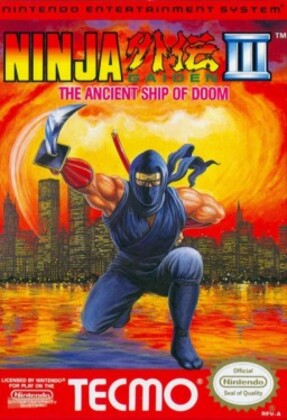
Picture this: you just beat Ninja Gaiden II at a friend’s house, spent a solid month bragging about it, and then Tecmo drops episode three into stores and demolishes your confidence in about four screens. That was the summer of 1991 for a lot of NES kids. Ninja Gaiden III: The Ancient Ship of Doom hit North America in August 1991, two months after Japan got it on Famicom as Ninja Ryukenden III. Tecmo still handled the whole thing, developer and publisher both, with Masato Kato stepping in to design it after Hideo Yoshizawa, the guy who built the first two games, moved on to other projects.
Ryu picked up some new tricks this round. He can hang from pipes and vines, then swing up or drop down, though he can only strike with a secondary weapon from that position. Wall climbing got smoother and more forgiving. A new power-up called the Dragon Spirit Sword extends his blade’s reach, and a ninja art called Vacuum Wave fires blades above and below him at the same time. What got cut is almost as notable as what got added: the cloning power-up from Ninja Gaiden II is gone, and so is that game’s jump-and-slash move.
Here’s the part collectors still bring up: usually this works the other way around. Localized NES games almost always got easier crossing the Pacific, not harder. Tecmo flipped that script completely. American enemies deal roughly double the damage of their Japanese counterparts, so a hit that used to cost one health bar now costs two, and one that cost two now costs three. Spikes and electric fences that drained three points now drain six. Enemy placement was rearranged across every single stage specifically to make dodging harder, the checkpoints inside each sub-act disappeared, and continues got capped at five total. The Japanese version’s password system, which let you bank unlimited attempts, vanished entirely from the American cartridge.
There’s a smaller, stranger change buried in the ending screen. The Japanese version closes with a line reading “TO BE CONTINUED NINJA RYUKENDEN-II,” which places this game’s story between the first two NES entries instead of after them. The US version simply cut that line, and the American box and manual lean the other direction, hinting this adventure happens later in Ryu’s timeline. Ninja Gaiden II ended with Ryu losing his Dragon Sword, and this game hands it right back to him with no real explanation. Tecmo never bothered smoothing that over for American players.
Critics loved the extra punishment at the time. All four Electronic Gaming Monthly reviewers scored it 8 out of 10, GamePro gave it 24 out of 25, and Nintendo Power handed it a “Best Challenge” award for 1991. Retrospective reviews have been less generous, picking apart the uneven level design and a plot that one British outlet described in far less polite terms than we’ll use here.
Hunting a graded copy for your own shelf? Condition on this one comes down to the usual NES suspects. Label gloss and corner wear matter. So does whether the cartridge’s pins show any corrosion from decades sitting in a damp basement. Our gallery of graded video games gives a sense of what clean, high-grade Tecmo cartridges from this era are pulling these days. Ancient Ship of Doom isn’t the rarest game on anyone’s want list, but a crisp, complete copy still holds up as a genuinely fun entry worth tracking down, assuming you’re ready for Tecmo’s idea of a fair fight for American players. For the full rundown on the version differences, Wikipedia’s entry digs into the rest.