

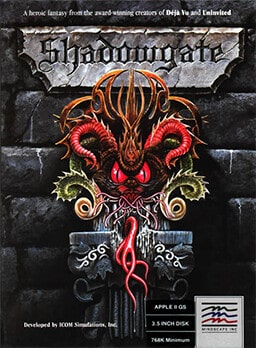
You rented Shadowgate expecting another action game, because in 1989 that’s what an NES cartridge was supposed to be. Ten minutes in, your torch burned out, you took two steps in the dark, and a caption told you exactly how you’d just broken your neck. That was the whole appeal. Shadowgate wasn’t about reflexes. It was about reading the screen carefully enough to survive it, and most players didn’t.
The game started life in 1987 on the Macintosh, built by ICOM Simulations as part of its MacVenture series. Designers Dave Marsh and Karl Roelofs sketched the whole world out of a single image: an illustration in the Advanced Dungeons & Dragons Dungeon Master’s Guide showing someone fleeing a flooding room past a skeleton. That one picture became Castle Shadowgate, home of the Warlock Lord, and a point-and-click adventure where every room hid a different, usually fatal, problem.
Kemco brought it to the NES in December 1989, three months after a Japanese release, and the conversion wasn’t obvious. Shadowgate on the Mac ran on overlapping windows and a mouse cursor. Kemco rebuilt the whole interface in sprites so it would work with a D-pad and two buttons, a pitch Marsh and Roelofs weren’t sure would hold up. It held up fine. More people met Shadowgate through that cartridge than ever touched the black-and-white original, and for a generation of NES owners, the NES version is simply the game.
The torch mechanic is the engine behind everything. Let it run out and you die. Walk into the wrong statue and you die. Mix two items that shouldn’t touch and the Grim Reaper shows up mid-puzzle just to make fun of you before finishing the job. Marsh has said he built the deaths to land as funny or absurd rather than grim, describing his goal as making each one sound “painfully stupid” instead of anything darker. It mostly worked. Kids who never finished the game still remember specific ways they died decades later.
Something got lost and gained in the English localization along the way. Certain wrong-item combinations trigger the line “you pulled a boner,” an idiom that read fine to Kemco’s translators and reads a little different to modern eyes. It’s one of the more quoted lines in the whole game. That same text-heavy death system is also how Shadowgate slid past Nintendo’s notoriously strict content rules of the era: no graphic violence on screen, just a sentence describing exactly how badly you’d failed. Monster Party pulled a similar trick with actual blood two years later, disguising it as something else Nintendo’s reviewers would wave through.
Reviewers liked it at the time. Computer Gaming World singled out the interface as a step up from earlier adventure games, and Dragon magazine gave it a full five out of five stars. Later ports fared worse critically, which says more about the adventure genre aging than about this specific version.
A complete Shadowgate cartridge isn’t a five-figure grail. It’s common enough that most collections have room for one. That’s actually its appeal for anyone building out an NES library for grading: box condition and manual completeness matter more than scarcity here, and it’s a manageable way to add a genuinely different genre to a shelf full of platformers and shooters.
The game outlived its era. A 2014 Kickstarter remake raised over $137,000 and rebuilt the whole thing with new art and voice acting, followed years later by a Playdate port. Not bad for a cartridge that spent 1990 teaching an entire generation to read every line of text before touching anything in a dark room.