

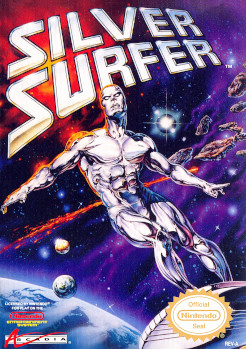
You rented this one because of the cover, not the comic. A chrome surfer riding a board through space looked cool enough on the shelf at the video store, and nobody checks a license that closely before dinner. Then you pressed start, and something off-screen killed you before you’d even figured out which button fired your weapon. That’s the Silver Surfer experience in one sitting, and three decades later it’s still the reaction most people have to this cartridge.
Silver Surfer came out exclusively for the NES in November 1990, built by Software Creations and published in North America by Arcadia Systems. It’s a side-scrolling shooter based on the Marvel character, and the plot is appropriately cosmic: Galactus sends the Surfer out to deal with a lineup of villains that includes Mephisto, Fire Lord, and a final boss whose health bar oddly resembles Mister Sinister, an X-Men villain who has nothing to do with this particular mission.
The game alternates between side-scrolling and overhead stretches, and each section ends with a mini-boss that freezes the screen scroll until you win or die. You fire a stream of silver pellets, grab “option” orbs you can reposition with the B button, and pick up power squares that either beef up your shot or hand you a bomb that clears the screen. Lose a life and all of it goes away at once — spheres, firepower, bombs, gone. A password system lets you jump to any level and even dial in invincibility, the same trick Mega Man used around the same era.
None of that explains the reputation, though. Silver Surfer gets lumped in with the handful of NES games that taught a generation what “hard” actually meant, and at release, critics noticed. GamePro called it “easily one of the toughest shooters around.” EGM’s reviewers landed around 7 out of 10 across the board, with one writer noting it was “nothing really new and innovative, just a good solid shooter” — faint praise for a game that would go on to wreck controllers for years. Nintendo Power split the difference, calling it fun and challenging while admitting it could frustrate.
What everyone agreed on, then and now, is the music. Tim and Geoff Follin wrote the score, and it’s routinely cited among the best soundtracks the NES ever produced — the kind of thing people pull up on its own, with no footage attached, just to hear what the console’s sound chip could do in the right hands.
Here’s the twist nobody expects: Kevin Edwards, the programmer who actually built Silver Surfer, doesn’t buy the impossible-game myth. He’s said publicly that the difficulty got exaggerated over the years, spreading by word of mouth until the legend outran the cartridge. Whether or not you believe him, the internet apparently still doesn’t — a 2026 patch from ROM hacker BillyTime!Games shrinks the hitbox, boosts your shot damage, and throws in infinite lives, released in the same batch as fixes for X-Men 2: Clone Wars and Marvel Super Heroes in War of the Gems.
Marvel-licensed NES carts are a mixed bag for collectors, the same way they are for players — plenty of licensed games from this era range from genuinely good to legendarily rough, and buyers pay attention to which bucket a cartridge falls into before they pay up for a graded copy. Silver Surfer sits on the better end, helped along by Joe Jusko’s painted cover art, which is a notch above the usual licensed-game box work of the period. If you’re hunting a copy for your own collection, condition on these boxes matters as much as the cartridge — check out our gallery of graded games to see what a well-preserved copy actually looks like next to one that’s seen too many rentals.
So no, it’s probably not the hardest game on the console. It just felt that way to a kid holding a controller with no idea a comic book existed behind the cartridge.