

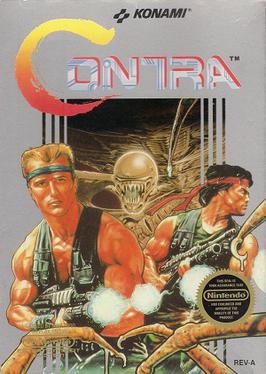
Before Contra’s title screen even faded in, your fingers already knew what to do. Up, up, down, down, left, right, left, right, B, A, Start. Nobody handed you an instruction manual for this one. It just traveled, kid to kid, driveway to driveway, until every NES owner in America seemed to know thirty lives when they should have had three.
The code wasn’t born in Contra, though. It came out of a 1986 Nintendo Entertainment System port of Gradius, Konami’s brutally difficult arcade shooter. Programmer Kazuhisa Hashimoto was the one stuck testing it, run after run, and he got tired of dying before he’d even reached the parts of the game he needed to check. So he built himself a shortcut: enter a specific sequence while the game was paused, and it loaded every weapon upgrade at once. It was meant to disappear before release. It didn’t. The team found it late in development and decided pulling it out risked breaking something else that close to the deadline. They shipped it instead, buried in the code, figuring almost nobody would stumble onto it.
Gradius players in Japan found it fast. What turned it into an American legend was Contra, Konami’s 1988 run-and-gun and one of the toughest two-player games on the NES. Castlevania’s equally unforgiving stablemate, as it happens, which we got into recently in our head-to-head against Ghosts ‘n Goblins. Entered at Contra’s title screen, those same ten inputs swapped the standard three lives for thirty, just enough to actually survive the gauntlet. The trick picked up a nickname almost as famous as the code itself: the Contra Code, or simply the 30 Lives Code.
Contra sold around two million copies in North America and picked up Electronic Gaming Monthly’s Best Action Game award for 1988, numbers that owe a lot to the two-player co-op nobody could resist. Enough kids watched a friend type the sequence in that it outran any strategy guide. By the time Nintendo Power printed it as an open secret, the surprise was gone. The ritual of typing it in never got old.
That ritual outlived the console, outlived Konami’s arcade dominance, and arguably outlived Hashimoto himself, who died in 2020 having spent his career mostly uncredited for what’s become the single most famous line of input in video game history. It shows up in Wreck-It Ralph. A Moldy Peaches song references it. It still works as an Easter egg on more websites than anyone has bothered to count. Modern games keep finding new excuses to hide it: Fortnite used it to unlock a minigame in 2019, Bloodstained: Ritual of the Night ties it to an entire difficulty mode, and asking Siri or Alexa to run through it gets you a joke instead of an error.
None of that rarity applies to the code itself. The chip inside every surviving Contra cartridge still remembers it perfectly, no matter the cartridge’s condition. What collectors actually chase is everything around it: a box like the one pictured here with sharp corners and unfaded color, a manual that never got used as a coaster, a label that never had a sticker peeled off it. That’s the difference between a cart worth playing and one worth grading. The code plays the same either way. Only one of those copies holds its value.
Thirty lives, zero royalties, one very patient bug nobody dared remove.