

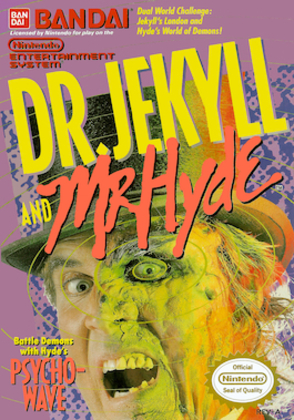
Picture an NES game where the hero can barely fight back. Where your character can’t jump over most obstacles. Where getting hit doesn’t kill you — it turns you into someone else, flips the entire level, and sends you walking the other direction. That’s the pitch for Dr. Jekyll and Mr. Hyde, and it’s exactly as confusing to play as it sounds. It’s also one of the most talked-about “bad” games on the whole system, which is a strange kind of immortality for a cartridge almost nobody bought.
The setup is simple: Dr. Jekyll is walking to his own wedding. That’s it. He crosses six stages of English countryside and city streets, and since he’s a mild-mannered doctor, he can’t really attack anything — his cane only works on bees. Everything else, you avoid. Startling encounters (a barking dog, a runaway carriage) fill up an Anger Meter, and once it’s full, Jekyll transforms into Hyde. The screen flips, scrolling reverses, and now you’re playing a different character entirely, firing a “psycho wave” at monsters to calm down and turn back into Jekyll. Hit the right kind of creature (Shepp monsters refill the meter fastest) and you can speed the process along. Let Hyde wander back to the spot where Jekyll transformed, though, and he gets struck by lightning and dies. Whoever reaches the church first decides which ending you get.
Bandai brought it to North America in July 1989, a little over a year after Toho had published it in Japan for the Family Computer as Jekyll Hakase no Hōma ga Toki — roughly “Dr. Jekyll’s Hour of the Wandering Monstrosity.” Advance Communication Company developed both versions, though the US release reordered the stages and cut some segments and sprites from the original. Famitsu’s four reviewers split between 3, 6, 6, and 4 out of 10 at the time, and Famicom Hisshoubon landed at 2.5 out of 5 — middling, mostly frustrated scores. Oddly, the German magazine Aktueller Software Markt called it one of the better NES releases of its era, so even in 1989 opinions on this thing were all over the map.
Retrospective reviews have not been kind. AllGame gave it 1.5 out of 5. Game Informer scored it 0.5 out of 10, writing that it was “flawed on every fundamental level.” Eurogamer’s line was blunter: the game “does everything so perfectly wrong.” For decades, that reputation was basically its whole legacy. Dr. Jekyll and Mr. Hyde sold poorly and drew almost no attention. It faded into the pile of licensed NES games nobody thought twice about.
Then James Rolfe reviewed it as the Angry Video Game Nerd. Rolfe has said the review had the opposite of its intended effect: instead of warning people away, it made them curious enough to track the game down and see the mess for themselves. That’s how a game this obscure ended up namechecked on worst-games lists for a generation that never touched an NES cartridge in its life.
None of this makes Dr. Jekyll and Mr. Hyde a hot commodity on the grading side. It never sold well enough to get stockpiled the way genuinely popular NES titles did, so complete-in-box copies aren’t scarce in the way a Black Box classic might be. If you’re chasing something affordable with a story attached rather than a five-figure rarity, this is closer to what that looks like — a game people talk about far more than they ever played.
We namechecked this one back in our rundown of the creepiest games on the NES without giving it the full spotlight treatment. Same story with Friday the 13th, another licensed game that built its reputation the hard way. If you’re building out a collection around oddities and notorious misfires rather than chase cards, our gallery of graded games is worth a look for what that kind of collecting can turn into.