

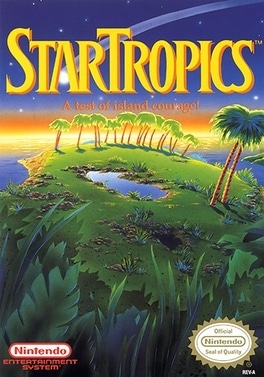
Somewhere in a kitchen in early 1991, a kid stood over the sink holding a folded paper letter under the faucet. His NES sat paused on the title screen in the next room. This wasn’t a prank, and it wasn’t a mistake. Nintendo told him to do it.
That’s StarTropics, released for the NES in December 1990 and published directly by Nintendo rather than a third party. It was directed by Genyo Takeda at Nintendo’s in-house Integrated Research & Development division, the same team that shaped Punch-Out!! and Kirby’s Adventure. You play Mike Jones, a Seattle teenager who flies to the fictional C-Island to visit his archaeologist uncle, only to learn he’s been abducted by aliens. Armed mostly with a yo-yo, a genuinely odd choice of weapon nobody at Nintendo has ever fully explained, Mike works through a string of tropical dungeons that borrow heavily from The Legend of Zelda’s structure while adding hole-digging, a submarine, and enemies built out of coconuts and fish.
The game’s real legacy has nothing to do with yo-yos. Partway through, Mike receives an in-game letter from his uncle that appears blank on screen. The solution wasn’t anywhere in the game. It was in the box. StarTropics shipped with an actual paper letter, and the only way to read the hidden message was to dip that physical piece of paper in water, revealing an invisible-ink code needed to continue. Miss it, lose it, or toss it out with the packaging, and the game simply stops for you. No hint screen. No in-game nudge. Nintendo eventually printed the code in Nintendo Power for anyone who’d already thrown the letter away.
Critics argued over how well the Zelda comparisons held up. IGN later called StarTropics “the natural evolution of the original Legend of Zelda,” while at least one contemporary review dismissed it as derivative. That debate didn’t stop it from becoming a Nintendo Power favorite, and the magazine eventually ranked it among the 100 greatest games it had covered. A 1994 sequel, Zoda’s Revenge: StarTropics II, kept the gag alive by having Mike hold the letter up to a mirror instead of dunking it, a cheaper trick with the same spirit. Neither game was ever released in Japan, making StarTropics one of the rare Nintendo-published NES titles built exclusively for a Western audience, likely because the water puzzle made localization more trouble than it was worth.
That paper letter is also why StarTropics is a minor headache for anyone chasing a complete graded copy today. A loose cartridge is cheap, often under $15. A complete-in-box copy with the letter intact regularly sells for two to three times what an identical CIB copy without it brings, because that single sheet of paper is the rarest and most fragile piece of the whole package. It’s the same story behind Little Nemo: The Dream Master a few days back: completeness in this hobby often comes down to the small paper inserts nobody thought to save. If you’ve got an old StarTropics box in a closet, it’s worth checking what actually counts toward a grade before you assume it’s just a cartridge.
Most NES oddities fade once the gimmick feels dated. This one still works. Somewhere out there, someone is dunking paper in a sink for a thirty-five-year-old video game code. That’s a good trick.