

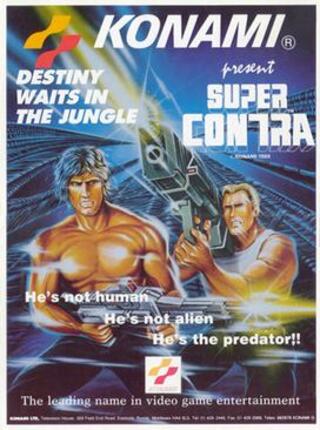
Rent a Contra sequel in the spring of 1990 and you’d notice the box said something different than you expected. Not Super Contra, the name on the arcade cabinet down at the pizza place. Just Super C. Same two soldiers, same jungle, enemies still pouring out of the trees like someone upended an anthill. Nobody explained the switch at the time. You just played it.
The arcade original came from Konami in January 1988 in Japan, hitting North America that March under the full Super Contra name. It did well enough that Game Machine ranked it the fourth most successful table arcade unit in the country that spring. The Famicom port followed in Japan on February 2, 1990, with the North American NES release landing April 5, 1990. Programmer Shigeharu Umezaki led that conversion, and it sold more than 500,000 copies according to a Konami marketing binder from 1991. Solid numbers for a sequel riding on a word nobody would print on the box.
That word is the interesting part. It’s widely believed, though never officially confirmed by Konami, that the NES version got trimmed to Super C specifically to put distance between the game and the Iran-Contra affair, which was still fresh enough in 1990 to make a kids’ toy company nervous. The Japanese Famicom release kept the full Super Contra title. Only the American cartridge got the haircut.
Mechanically, this isn’t just Contra with new wallpaper. Konami dropped the pseudo-3D pyramid stages and swapped in overhead, eight-directional sections that play more like a top-down shooter than a run-and-gun. You can now control how high you jump by holding up or down mid-leap, which sounds minor until a boss pattern depends on it. Grab the same weapon twice and it upgrades instead of just resetting your ammo. A hyper shell power-up clears the whole screen and can be stockpiled for later, and either player can jump back in with a continue at any point instead of waiting for the other to burn through every life first.
One other change: the Konami Code doesn’t work here. Super C ships with its own, different cheat for extra lives, quietly retiring the most famous button combination in gaming for its own sequel. Reviewers didn’t seem to mind the substitutions. All four Electronic Gaming Monthly critics gave it 8 out of 10, AllGame handed it 4 out of 5, and it sits around 75% on GameRankings’ NES aggregate, respectable numbers for 1990.
Europe never got Super C at all, at least not by that name or with those characters. PAL territories received it in August 1992 as Probotector II: Return of the Evil Forces, with the human soldiers swapped out for robots, part of the same localization pattern Konami used across the Contra line overseas.
For collectors, Super C sits in a comfortable middle tier. It’s common enough that raw loose copies are cheap, but a sealed, high-grade example with crisp box corners and an intact seam still draws real money at auction, since most surviving copies spent the 90s getting rented and returned rather than shelved. Browse our gallery of graded NES cartridges to see what that kind of condition actually looks like, and if you’re chasing a copy for a collection built around Konami’s catalog, it pairs naturally with the original Contra, which we covered a while back.
Thirty-five years later, the name change is a trivia footnote. The game underneath it still holds up as one of the better sequels Konami put on the system, scandal-dodging title and all.