

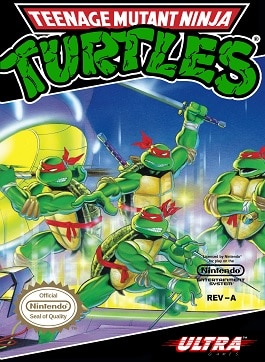
Every kid who booted up this cartridge in the summer of 1989 has the same memory. You’re underwater, disarming a bomb, and something that never actually touched your turtle knocks off half your health bar anyway. That water level wrecked more childhoods than any boss fight in the game. Kevin Eastman, the man who co-created the Turtles, admitted years later that he still can’t beat it: “I never made it through the water level and I’ve tried and tried and tried.” If the guy who invented these characters can’t clear level four, you were never the problem.
Konami built the game and shipped it in North America in June 1989, a few weeks after the Japanese Famicom version landed that May under the name Geki Kame Ninja Den. Konami didn’t even put its own name on the box. The company had already hit Nintendo’s old limit of five games per publisher per year, so in 1988 it spun up a second label, Ultra Games, purely to sneak more titles onto shelves. This game became one of Ultra’s biggest bets. It paid off in a way nobody at Konami could have planned for.
The cartoon was still climbing toward its peak when the game shipped, and the timing turned out perfect. The game went on to sell more than 4 million cartridges worldwide by the end of 1990, and Konami has said it generated roughly $125 million in revenue, north of $325 million today. By 1991 it was the best-selling third-party game on the entire NES, outselling plenty of titles that reviewed far better.
That’s the strange part. Critics at the time were genuinely split. British magazines like Mean Machines and Computer and Video Games scored it in the high 80s and 90s, praising the mix of overhead city stages and side-scrolling combat across all four turtles, each with a different weapon and reach. Electronic Gaming Monthly’s review panel wasn’t nearly as generous, with scores ranging from four to seven out of ten. Modern retrospectives have been rougher still. GameSpot handed it a 2.7 and called the difficulty unfair rather than challenging, and reviewers have pointed to graphical slowdown and glitches that never got patched, because nothing got patched in 1989.
The dam level earned its reputation honestly. The programmers built in a water current that shoves your turtle around the screen at a random speed, and the hit detection is loose enough that seaweed can knock off health before it’s anywhere near your sprite. You’ve got a strict timer to disarm eight bombs while all of that is happening. It’s the kind of design that reads fine on paper and turns into chaos the moment a controller is actually in your hands.
On a friendlier note, this is also the game that introduced pizza as a health pickup — whole pies, half a pie, even a single slice, each restoring a different amount. It’s such a natural fit for the franchise that it became a fixture of nearly every Turtles game that followed. The roster also leans on Bebop and Rocksteady, two mutant henchmen invented for the 1987 cartoon and nowhere in the original Mirage comics that started the whole franchise, a small reminder of how much the games owed to the TV show rather than the comic books.
With roughly 4 million cartridges out there, loose copies are easy to find today and cheap by NES standards. A complete-in-box copy is a different story. The print run was massive, but three and a half decades of basement storage means box art condition and manual completeness vary wildly from one copy to the next, which is exactly the kind of thing our grading process is built to sort out. If you’re curious how another licensed cartoon cash-in from the same stretch of years turned out, our DuckTales spotlight covers Capcom’s much better-reviewed answer to the same formula, released just a year later.
One more oddity worth knowing: in the UK, “ninja” was considered too aggressive a word for children’s programming, so the whole franchise got rebranded Teenage Mutant Hero Turtles, right down to the box and cartridge label. Nintendo bundled that version with the console for the 1990 holiday season, and it’s credited with helping the NES pull ahead of the Sega Master System in the UK for good. Not bad for a game its own co-creator can’t finish.