

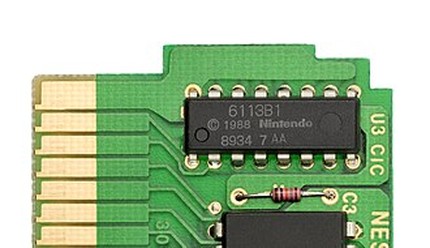
You’ve seen the blink. A cartridge goes in slightly crooked, the power light flickers red over and over, and the screen stays gray no matter how many times you pull the cart halfway out and blow on the connector. Every NES owner in the 1980s thought that blink was a hardware problem. It wasn’t. It was a 10-cent chip doing exactly what Nintendo built it to do: refusing to run a game it didn’t recognize.
That chip had a name, the 10NES, and it changed the entire shape of the console’s library before a single player ever picked up a controller.
Nintendo built the 10NES as a direct response to the North American video game crash of 1983, when a flood of cheap, rushed third-party cartridges for the Atari 2600 convinced retailers and parents that the whole industry was junk. When the Seal of Quality was the public-facing promise that an NES game had been checked, the 10NES was the part nobody saw, quietly enforcing that promise at the hardware level. Every console shipped with a lock chip; every licensed cartridge shipped with a matching key chip. If the handshake failed, the console reset itself once a second, which is exactly the blinking you remember.
Licensing came with real costs attached. Nintendo controlled how many games a company could release per year, took a cut of every cartridge sold, and required its own manufacturing. Some publishers decided that was a deal worth skipping entirely.
Color Dreams found a workaround and started selling games in baby-blue cartridges that bypassed the chip outright, no license required. Camerica did something similar in gold and later silver shells, generating glitch pulses that froze the lockout check before it could finish. Neither company’s games carried the Seal of Quality, and collectors today still treat that absence as a meaningful marker. An unlicensed cartridge from this era isn’t rarer by default, but it tells a different story than a Black Box launch title, and that story matters when a grader is writing up a cartridge’s background.
The real fight happened in court. Atari Games, through its NES-focused subsidiary Tengen, tried reverse-engineering the 10NES and failed. So in 1988, Atari’s lawyers requested the chip’s actual source code from the U.S. Copyright Office, claiming they needed it for a pending lawsuit. There wasn’t one yet. They used that code to build a clone called the Rabbit chip and started selling unlicensed cartridges under the Tengen label anyway.
Nintendo sued. The case dragged on for years. A federal appeals court sided with Nintendo in 1992, and the two companies finally settled in 1994, with Atari paying up. The irony is that Atari’s underlying argument, that reverse-engineering a lockout system can be fair use, was basically correct. A different case decided around the same time, Sega v. Accolade, made exactly that point and won. Atari just got there by lying to a federal office first, and that’s what sank them.
The 10NES patent expired in 2006, decades after it mattered to anyone shopping for a game. By then the chip had already done its job: it decided who got to publish on the NES at all, and that decision still shapes which cartridges show up in grading submissions today. A straightforward licensed cart tells one kind of story. One of Camerica’s silver-shelled oddities, or a Micro Machines cart that never asked Nintendo’s permission to exist, tells another. Both are worth knowing before you decide what you’re holding is actually worth.