

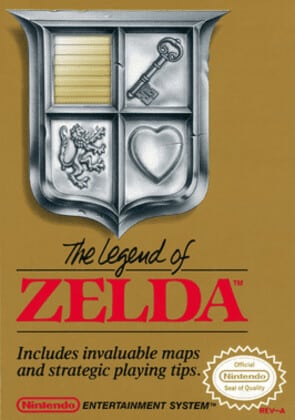
You pull the gold cartridge out of its cardboard sleeve, and it already feels different. Not another gray brick. A gold one, with a window cut into the box so you could see it glinting before you even opened the flap. Nintendo wanted you to know this game was special before you played a second of it, and for once the marketing wasn’t lying.
The Legend of Zelda started life on the Famicom Disk System in Japan on February 21, 1986. North American players got the NES cartridge version on August 22, 1987, about a year and a half later, developed in-house by Nintendo R&D4 and directed by Shigeru Miyamoto alongside Takashi Tezuka. It sold big everywhere it landed: roughly 6.51 million copies worldwide, with North America alone moving around 3 million cartridges by 1990. For a console still climbing out of the wreckage of the 1983 crash, that’s not a small number. That’s a system-seller.
Here’s the part that mattered more than the sales chart. The cartridge had a battery inside it, wired to a small chunk of RAM, so the game could remember exactly where you left off. Die mid-dungeon, turn the console off, come back three weeks later — your file was still there. That sounds trivial now. In 1987 it was new. Most games reset you to zero every time, and Zelda quietly broke that rule, which is a big reason it could get away with a map this large and a story this loose. You weren’t expected to finish it in one sitting, because for the first time, you didn’t have to.
And the map really was large for its era, deliberately vague about where to go next. Link starts in a forest with a sword he found under a rock and an old man’s cryptic advice, and from there the game mostly gets out of your way. Critics at the time zeroed in on exactly that: reviewers praised the sheer variety of weapons and secrets tucked into the overworld, and how none of it felt padded despite the size. Compare that to the linear, level-by-level structure most NES games followed, and it’s obvious why Zelda still gets cited as one of the originators of open, non-linear console design. Check the different NES print variations of Zelda sometime — the cartridge label and box design actually changed across production runs, which matters if you’re trying to figure out exactly what you’re holding.
One more detail worth knowing: that famous overworld theme almost wasn’t original at all. Composer Koji Kondo initially planned to license Ravel’s Boléro for the exploration music, then found out Japanese copyright law wouldn’t clear it in time. He wrote the replacement theme in about a day. It’s now one of the most recognized eight bars in gaming, and according to the game’s history, it exists because a legal snag forced a rewrite under deadline pressure — not exactly the origin story you’d expect for a piece of music this iconic.
For collectors, Zelda sits in a strange spot. It sold well enough that raw loose copies aren’t rare, but a complete-in-box example with the gold cartridge intact, correct manual, and matching label insignia is a different conversation entirely — small print and packaging differences shift what a given copy is actually worth. If you’ve got one sitting in a drawer and want to know what you’re really looking at, our grading process breaks down exactly how condition and authenticity get assessed. Worth a look before you assume “gold cartridge” automatically means “valuable” — it doesn’t, not on its own. Context does.