

Somewhere out there, someone is still flipping through a bin of dollar-store NES cartridges, unaware they might be one label away from a five-figure find. It happens more than collectors like to admit.
For years, the easy assumption was that a rare NES game meant a bad one — something nobody wanted, still sitting on a shelf decades later. That’s backwards. The cartridges that command the biggest prices today are rare for the opposite reason: almost nobody had the chance to buy them the first time around, whether because of a distribution deal that fell apart or a print run that barely left the warehouse. Quality has surprisingly little to do with it. Here’s a look at the cartridges sitting at the top of that list, and the stories behind why they got there.
Nintendo World Championships 1990
Nintendo built exactly one purpose for this cartridge: a national competition. Ninety finalists at the 1990 Nintendo World Championships each received a gray copy, custom-coded to run three timed minigames — Super Mario Bros., Rad Racer, and Tetris — inside a single six-minute-and-21-second window, scored on a formula Nintendo never fully explained. A rarer gold version, with roughly 26 known copies, went out later as a Nintendo Power sweepstakes prize. One gray cartridge sold for $100,000 on eBay back in 2014. That number hasn’t gone anywhere but up since. It’s generally considered the single most valuable standard NES cartridge in existence.
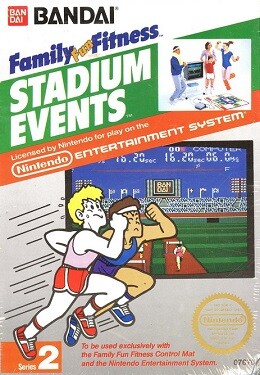
Stadium Events
Before there was a Power Pad, there was Family Fun Fitness — a floor-mat accessory Bandai built for the NES, paired with a running-and-jumping fitness game called Stadium Events. Nintendo liked the hardware enough to buy the rights outright, rebrand the mat as the Power Pad, and reissue the game under a new name: World Class Track Meet. The original Bandai-published Stadium Events barely made it onto store shelves before that switch happened. A sealed copy has sold for more than $35,000, according to Wikipedia, and it’s usually the first name that comes up in any conversation about NES rarity.
Nintendo Campus Challenge 1991
This one wasn’t built for retail at all. Nintendo produced a custom cartridge for a competitive tour held on college campuses, running modified versions of Super Mario Bros. 3, PinBot, and Dr. Mario. Almost none of the units survived the tour intact. Only a small handful are confirmed to exist today, and when one surfaced for sale, it fetched roughly $20,000 — a serious number for a game nobody outside the tour ever got to play at home.
Cheetahmen II
This one’s a stranger story. Cheetahmen II was an unfinished sequel that never got an official release — only six of its planned ten levels were even finished. In 1996, someone found roughly 1,500 unsold cartridges sitting in a Florida warehouse, unlabeled and repurposed from leftover Action 52 shells. Those cartridges are the only reason Cheetahmen II exists in collectors’ hands at all, instead of as a total ghost.
The Flintstones: Surprise at Dinosaur Peak
Taito released this one in October 1993, years after most retailers had cleared shelf space for the Super Nintendo. That timing alone gutted the print run. Complete copies have sold for well over $1,000 for more than a decade, and prices keep drifting upward as fewer surface.
Panic Restaurant
Another late-cycle release, from 1992. Panic Restaurant is a genuinely solid platformer that suffered from arriving right as retailers were clearing NES shelf space for newer hardware. Complete-in-box copies regularly draw hundreds of dollars, and pristine graded copies push well past that.
Little Samson
If you’ve read our Little Samson feature, you already know the outline: a genuinely great platformer from Taito that arrived in late 1992 to a market that had already moved on. Complete copies now run into four figures, which makes it something like the entry ticket into this club — still real money, just not car-payment money.
Donkey Kong Jr. Math
Proof that rarity doesn’t require intrigue. This is an educational cartridge nobody particularly wanted in 1983, an arithmetic game starring Donkey Kong Jr. Low demand meant a low print run, and a low print run means a complete copy today comfortably clears four figures despite being, by most accounts, a pretty forgettable game.
What ties this group together isn’t quality. Some of these are genuinely great games. Some are barely functional. What they share is scarcity that happened almost by accident, usually a canceled distribution deal or a print run that got cut short before demand ever caught up. It’s the same logic that drives grading value generally: what a copy is actually worth comes down to how many survived and what shape they’re in, which is exactly what pushed the sealed Super Mario Bros. we wrote about recently to a $3 million sale. If you want to see what that looks like up close, our gallery of graded cartridges is worth a look.