

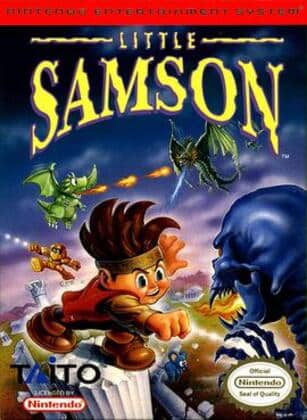
Picture a video store rental wall in November 1992, weeks before Christmas, stocked with new titles for a console everyone assumed was already on its way out. The Super Nintendo had been out over a year. Sega was running ads with Sonic doing donuts around Mario. And Taito quietly slipped Little Samson onto NES shelves with almost no marketing behind it. Most kids never noticed. That’s exactly why the game is worth talking about now.
Little Samson was developed by Takeru and directed by Shinichi Yoshimoto, who’d spent years at Capcom working on Ghouls ‘n Ghosts and Strider before striking out on his own. That pedigree shows. The game plays like a cousin of Mega Man, but with a twist Capcom never tried: instead of one hero, you control four at once, swapping between them mid-level with a single button press.
Each character solves a different kind of problem. Little Samson himself climbs walls and throws bells at enemies. Kikira is a dragon who flies in short bursts and breathes fire, with claws that grip ice. Gamm is a slow, spike-proof golem who hits like a truck. K.O. is a mouse — fragile, but fast enough to slip through gaps none of the others can reach. There are twenty stages, thirteen levels apiece, and the game expects you to juggle all four characters strategically instead of picking a favorite and coasting.
Reviewers at the time noticed the ambition. Nintendo Power called out the character-swapping as a genuine strategic layer, not a gimmick. Famitsu’s panel liked the audiovisual polish, though they wanted more intensity from the action. None of it moved the needle in North America. The game had already shipped in Japan back in June as Seirei Densetsu Lickle, and by the time it crossed the Pacific, most players’ attention, and money, had already moved on to 16-bit hardware.
That mistimed launch is the whole reason Little Samson matters to collectors today. A limited print run and a quiet North American rollout didn’t help either, and thirty years later, that combination is exactly why the cartridge is so hard to find. Complete-in-box copies routinely sell in the low thousands, and graded examples in top condition have cleared five figures. It’s a rare case where a game’s commercial failure and its critical reputation ended up moving in completely opposite directions. IGN eventually ranked it among the 100 best NES games ever made, and Retro Gamer called it one of the most technically impressive titles on the system.
The story picked up a new chapter recently. Limited Run Games spent years tracking down who actually owned the rights before announcing a proper re-release for modern platforms. That kind of resurrection doesn’t happen for games nobody cares about.
If you’ve got an original NES copy sitting in a box somewhere, it’s worth a second look before you write it off as just another cartridge. Rarity alone doesn’t set the price. Condition does the real talking, which is exactly why grading exists in the first place. Our pricing page breaks down what that process looks like for something like this.