

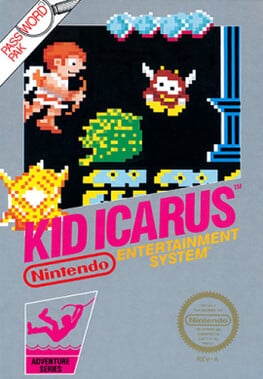
Long before Pit was picking fights with half the Super Smash Bros. roster, he was a scrawny angel stuck at the bottom of a mountain, and almost nobody inside Nintendo knew if his game would make it to shelves on time.
Kid Icarus launched on the Famicom Disk System in Japan on December 19, 1986, and reached NES cartridges in North America the following July. The gap between those two dates hides one of the roughest production stories in Nintendo’s early catalog. Designer Toru Osawa built the game mostly by himself through the first half of 1986. By August, it was obvious he wasn’t going to hit the deadline alone, so producer Yoshio Sakamoto pulled in staff from the Metroid team to help finish it. Osawa had just left for his honeymoon. He was back at his desk within two days.
What followed was three straight months of crunch. Staff slept on broken-down cardboard boxes in an unheated building through a Tokyo winter. A final boss stage got bolted on at the last minute because someone decided the game needed one more surprise. Osawa was still writing code three days before the Famicom Disk System’s manufacturing line needed a master copy, and his name didn’t even make it into the original credits. There wasn’t time to add it.
None of that chaos shows up on screen, which might be the most impressive part of the whole story. Kid Icarus sends Pit, an angel exiled from the sky by the sinister Medusa, through the Underworld, the Overworld, and Skyworld to recover the Three Sacred Treasures and free the goddess Palutena. It plays like two different games stitched together: brutal vertical climbing stages where a single fall wipes out your progress, paired with side-scrolling levels closer to a standard NES platformer. A bow with unlimited arrows is your only real weapon, and shops along the way sell hearts, upgrades, and the occasional cursed item. Eat the wrong eggplant and Pit turns into a walking vegetable until another character breaks the spell.
Critics in 1987 were split down the middle. Reviewers liked the score and the way the game blended genres, then knocked it for rough graphics and a difficulty curve that punished even careful players. It sold respectably without becoming a phenomenon, with worldwide sales landing around 1.76 million copies by the early 2000s. Then it went quiet. No new entry reached the West for over two decades, until Kid Icarus: Uprising arrived on the 3DS in 2012. What kept Pit’s name alive in the meantime was Super Smash Bros. Brawl in 2008, where he became a playable character and introduced an entire generation to a game most of them had never touched.
That’s part of the appeal for collectors today. Kid Icarus is a piece of NES history that got its second life through a completely different franchise, and complete-in-box copies still turn up regularly in graded auctions. The label art holds up better than plenty of games from the same shelf, and it’s worth checking corner wear and cartridge label gloss closely if you’re weighing a raw copy against a graded one. If the Metroid team hadn’t lent Osawa a hand, this one might have missed its window entirely.
Kid Icarus never asked to become a cult classic. It just happened to survive its own production schedule.